

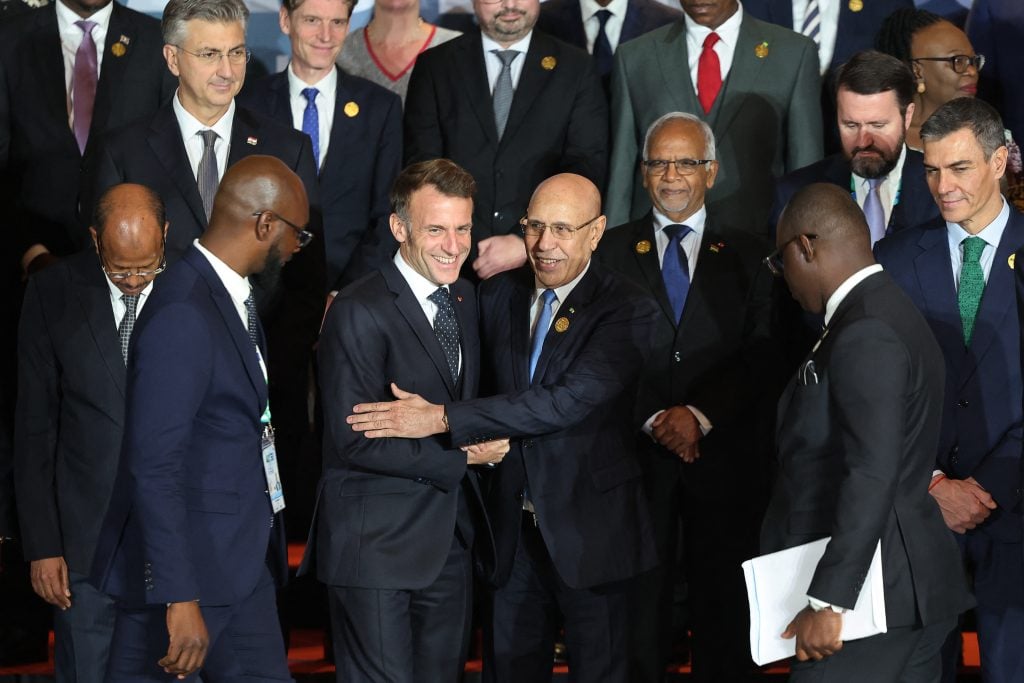
Motorcades swept along Luanda’s neon-lit waterfront at dusk, past idle cargo cranes and half-finished glass towers, before veering uphill toward the Salão Protocolar da Presidência – the angular concrete pavilion perched above the bay that hosted the seventh African Union-European Union Summit. Inside, beneath banners urging “effective multilateralism”, dozens of leaders converged to revive one of Africa’s most strategically significant partnerships.
The Summit delivered more than a routine communiqué. Europe backed African value-addition in critical minerals for the first time, recognised the blue economy as a strategic sector, and committed to building regional green-industrial hubs.
Together, the announcements mark a notable shift in Europe’s approach, from extractive trade patterns to co-investment and industrial partnership.
Europe backs value addition
While the EU is the top trading partner of African countries collectively and their largest export market, ahead of China, India and the United States, critics have long contended that limited value addition within Africa makes for a lopsided trading partnership defined by resource extraction and purchases of raw agricultural products.
One of the clearest wins for African leaders thus came in an area that has long been a sticking point: for the first time Europe formally backed Africa’s ambition to process critical minerals at home rather than export raw materials. The communiqué pledged support for “local and regional refining and processing of critical raw materials”, potentially unlocking financing for smelters, refineries and battery-precursor plants on African soil.
The move was linked the shift to the EU’s Critical Raw Materials Act, adopted in 2023 to diversify supply chains and reduce dependence on China. Luanda marks the first time that its logic has visibly extended to supporting processing in Africa.
Tighisti Amare, director of the Africa Programme at Chatham House, tells African Business that the move aligns with the economic priorities African governments have been stressing for years. “Africa is asking for more industries, more manufacturing, because we need so many jobs,” she says. Processing, whether through national or regional value-chain models, is central to that ambition. For her, Luanda “can be a turning point” if capital now moves into Africa’s productive capacity.
For Paul Walton, executive director of the Africa-Europe Foundation, the new minerals language is part of a wider recognition: that Africa’s growth depends on value addition, regional manufacturing and smarter capital deployment. “Where we need to focus now is the last mile of co-investment,” he says. “The task is to cement the investment case, build pipelines of bankable projects, and address misconceptions around risk.
“The old model of pledges and hand-outs has run its course,” he says. “Luanda was about co-investment, risk-sharing and building real value. The bottleneck is the last mile: getting money into projects at speed and scale.”
His foundation’s State of Africa–Europe 2025 report calls for streamlined approvals, better project pipelines and targeted de-risking tools to accelerate capital flows into energy, digital infrastructure and oceans. “What we need now is not just more money, but smart money,” he says.
A tighter window for delivery
Twenty-five years after the AU–EU partnership was launched in Cairo, progress on that front remains uneven. Critics say the “Joint Vision 2030” agreed in Brussels in 2022 has moved slowly. African officials regularly cite sluggish European procedures, delayed disbursements and limited risk appetite.
Meanwhile, Africa’s geopolitical choices have expanded. “Most African countries are now deliberately pursuing multi-alignment,” Amare tells African Business. “They work with China, the Gulf, India, Turkey and increasingly Russia. That gives them more leverage, and it pushes Europe to deliver differently.”
One institution adapting to Africa’s changing needs is the European Investment Bank (EIB). The EU’s lending arm sent vice-president Ambroise Fayolle to showcase projects it sees as “win-win” cooperation. Last year, 40% of the EIB’s external financing – €3.1bn – went to Africa.
“Africa has been a strategic partner for a long time,” Fayolle says. “At times of geopolitical uncertainty, the interlinkage between our economies becomes even more important.”
He highlights the Bank’s work on wind-power expansion in Cabo Verde, cocoa-sector traceability in Côte d’Ivoire, and new mRNA vaccine manufacturing in Rwanda, Senegal and South Africa – projects that pair African priorities with Europe’s climate, health and industrial objectives.
Fayolle acknowledges concerns that European financing is too slow and too conservative. To address this, the EIB says it is expanding mutual-reliance agreements with the African Development Bank, World Bank and others that allows lenders to rely on a single set of due-diligence documents rather than duplicating months of appraisal. “This reduces duplication and speeds up implementation,” he says.
Rethinking risk
For both continents, the most persistent obstacle to investment is perceived risk. Walton says that misconceptions about African investment conditions still block capital from flowing into high-potential sectors. “We need to continue to address misconceptions on risk and the idea that Africa lacks investment opportunities,” he tells African Business. “The challenge now is the last mile – scaling capital into real projects.”
Fayolle agrees, saying the biggest constraint on European financing is investor perception – and the absence, until recently, of reliable risk metrics. “Very often in Europe… what investors say is we lack data. We don’t have enough data to invest in Africa,” he says.
To counter this, he points to the Global Emerging Market Risk Database, a consortium created in 2009 but only recently expanded and opened more fully to the public. The platform pools anonymised, disaggregated credit-risk data from nearly 30 development banks and has sharply grown in coverage and granularity in the past two years, offering the first comparable, sector-level evidence of default and recovery patterns across regions.
“When you look at the figures, what you see is the region in the world that has the lowest credit risk is Africa,” Fayolle says. He hopes this new visibility will shift European boardroom decisions and accelerate approval of bankable projects.
A subtle pivot
The Luanda event followed swiftly on the heels of South Africa’s hosting of the G20 Summit. As one of the members of the G20, the European Union was represented at the Summit the highest levels.
In the months leading up to the event, European leaders strongly backed South African President Cyril Ramaphosa’s agenda, which focused on the concerns of Africa and other emerging nations.
“There’s been a lot of financing committed by the EU throughout the year towards South Africa in various industries,” says Chris Vandome, senior research fellow with Chatham House’s Africa and global economy and finance programmes. “The EU is really building up its Pretoria presence, to cover both South Africa and the region, so it’s really a focal point for them.”
Both Johannesburg and Luanda left the impression of a partnership quietly shifting gears. Europe’s first-ever endorsement of African mineral processing in Luanda, the emergence of robust risk data, and a stronger mandate for co-investment reflect a deeper recalibration.
Whether this marks a genuine reset or simply another rhetorical turn will depend on delivery. But Africa analysts say this summit moved long-discussed themes – value addition, green industrialisation, blue-economy investment and smarter risk-sharing – from the margins to the centre of AU–EU cooperation for the first time.
“There’s been a lot of financing committed by the EU throughout the year towards South Africa in various industries, says Vandome. “The EU is really building up its Pretoria presence, to cover both South Africa and the region. It’s really a focal point for them.”
