


Anthropic has launched Claude in PowerPoint, a Microsoft 365 add-in that embeds its Claude AI assistant directly inside PowerPoint. The tool is rolling out as a research preview for Claude Pro, Max, Team, and Enterprise subscribers. The add-in, distributed through Microsoft AppSource, integrates Claude into an active PowerPoint session.
It can generate new slides, edit existing ones, and build complete presentation structures from natural-language prompts while respecting the presentation’s existing slide master, layouts, fonts, and color schemes.
This release continues Anthropic’s push into productivity software by bringing Claude from standalone chat interfaces into document-based workflows.
How Claude Inside PowerPoint Works
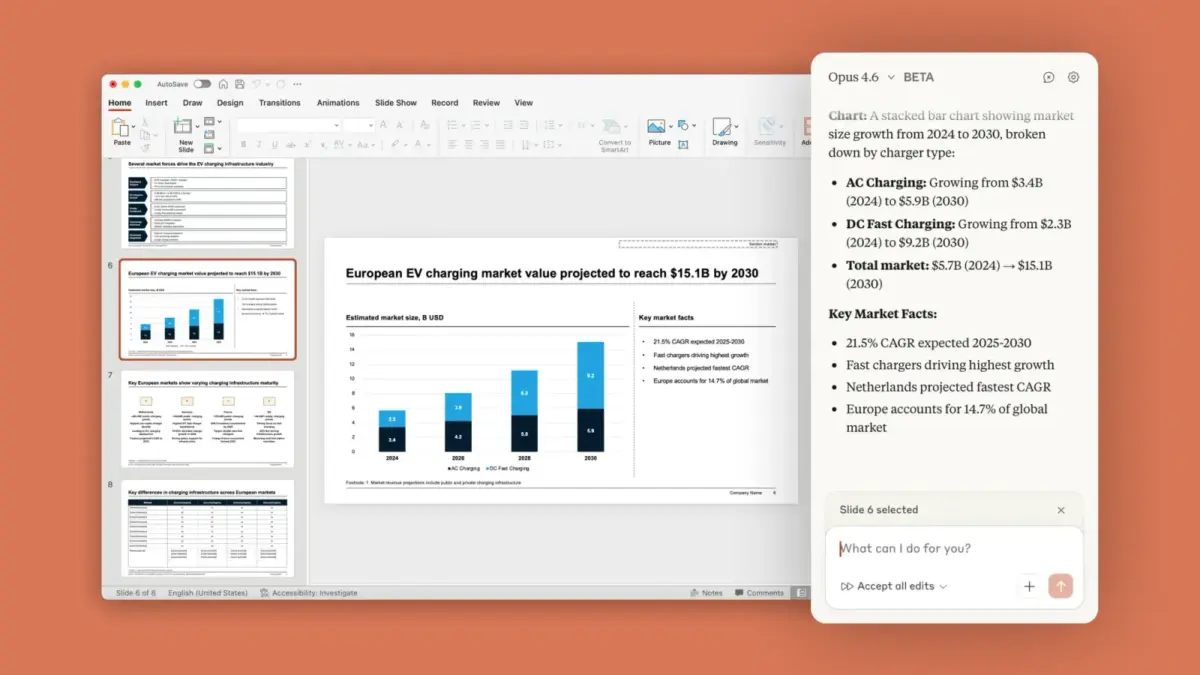
Anthropic says Claude first reads the open presentation’s slide master and formatting rules before generating or editing content. The idea is that any new slides follow the same layout, branding, and formatting constraints as the rest of the deck.
Interaction is prompt-based. Users describe what they want to create or modify, and Claude performs those actions in the currently open file.
Anthropic highlights three primary workflows:
- Generate slides from a prompt: For example, creating a competitive comparison slide using the current template.
- Edit specific slides or elements: Such as rewriting bullet points, simplifying dense text, or converting content into diagrams.
- Create full deck outlines: Turning a high-level description (e.g. a multi-slide industry assessment) into a structured presentation outline.
Charts and diagrams created by Claude are native PowerPoint objects, not static images. Users can continue editing charts, text boxes, and layouts after generation, just as they would with manually created content.
Claude in PowerPoint also lets users switch between Anthropic’s Sonnet 4.5 and Opus 4.6 models. Third-party testing has suggested that Opus 4.6 may be better suited for complex restructuring and Sonnet 4.5 for lighter edits, though Anthropic’s official documentation does not prescribe specific use cases for each model inside PowerPoint.
Integration With Claude In Microsoft Excel
Claude in PowerPoint follows Anthropic’s earlier Claude in Excel add-in, which focuses on spreadsheet tasks such as editing pivot tables, modifying charts, and applying conditional formatting.
With both Excel and PowerPoint supported, users can move from data analysis to presentation creation within the same AI ecosystem. Data prepared in Excel can be turned into visual slides in PowerPoint without manually recreating charts and tables.
Anthropic positions this workflow as a way to reduce repetitive formatting work and manual rebuilding when turning structured data into presentation materials.
Claude AI Limitations And Security Considerations
Anthropic currently describes Claude in PowerPoint as being in beta, and recommends that users review all AI-generated changes before finalizing important presentations.
The company lists several current limitations:
- Some advanced PowerPoint features may not yet be fully supported.
- Chat history is not saved between sessions, so context must be re-established when reopening the add-in.
- For Team and Enterprise customers, custom data retention settings are not yet inherited by the add-in.
- The tool is not currently included in Enterprise audit logs or the Compliance API.
Anthropic also warns about potential prompt injection risks. Because Claude can read the contents of the open file to understand context, malicious instructions embedded in templates or externally sourced documents could attempt to manipulate the model into exposing sensitive information or taking unintended actions.
To mitigate this, Anthropic advises using Claude in PowerPoint only with trusted files and avoiding untrusted external sources.
Availability Of Claude Inside PowerPoint
Claude in PowerPoint is available as a research preview for Claude Pro, Max, Team, and Enterprise subscribers. Anthropic has not provided a timeline for a broader public rollout.
The add-in remains in beta, and Anthropic says feature support, compliance integrations, and security safeguards are expected to evolve before a full production release.

