

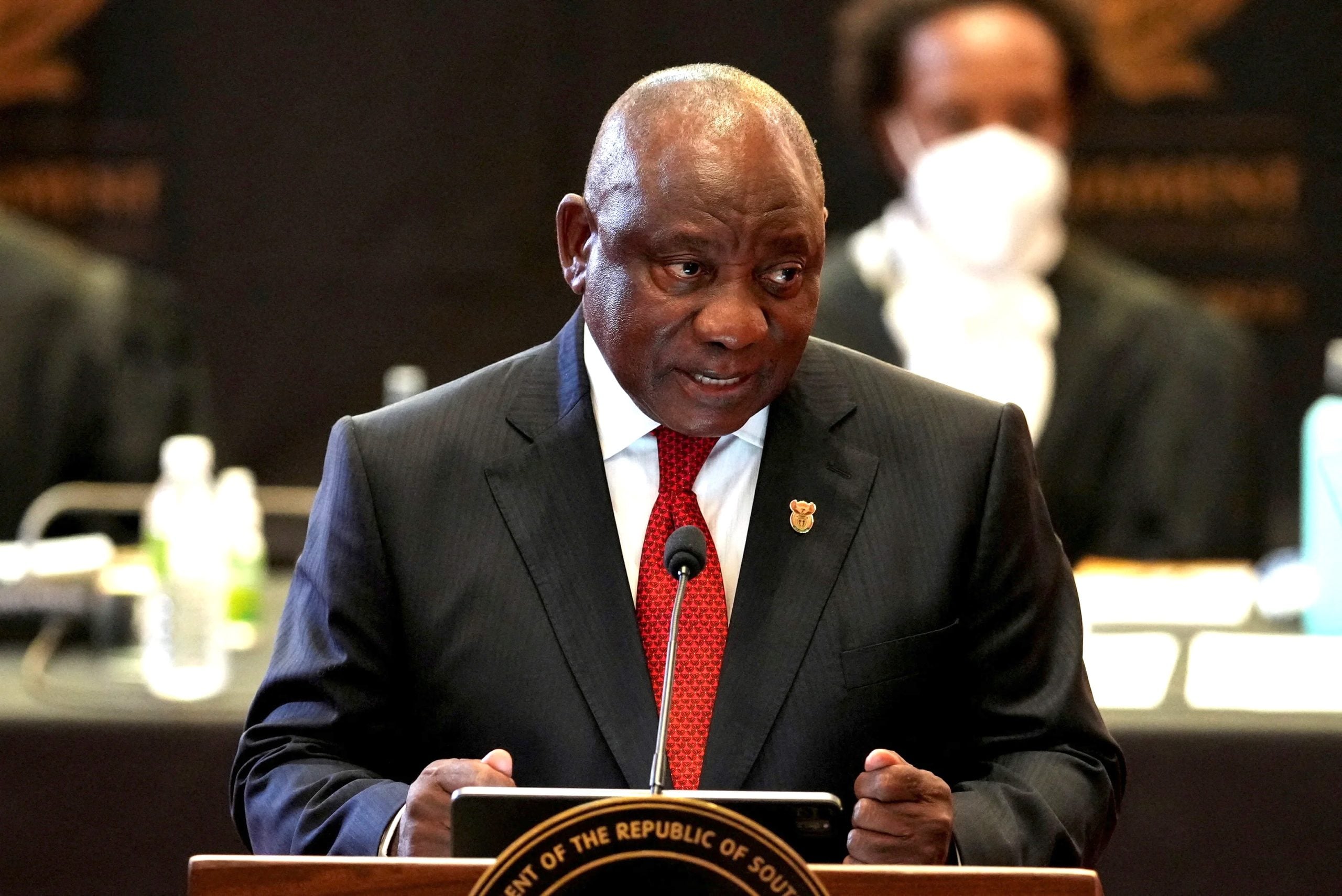
President Cyril Ramaphosa has maintained his innocence after South Africa’s Constitutional Court revived impeachment proceedings linked to findings that he may have a case to answer over the alleged concealment of a 2020 robbery at his Phala Phala game farm.
“While there have been calls in some circles that I should resign, nothing in the constitutional court judgment compels me to resign [from] my office,” he said during a late night televised address on 11 May, after a day of meetings with legal and political advisers and senior presidency officials.
I therefore respectfully want to make it clear that I will not resign.
To do so would be to pre-empt a process defined by the Constitution.
To do so would be to give credence to a panel report that unfortunately has grave flaws.
To do so would be to abdicate the…— Cyril Ramaphosa 🇿🇦 (@CyrilRamaphosa) May 11, 2026
Ramaphosa announced that he would apply to the high court to review the report drafted by an independent panel chaired by former chief justice Sandile Ngcobo and submitted to parliament.
The report concluded that Ramaphosa may have acted inconsistently with his office and created a potential conflict between his official responsibilities and private interests. However, Ramaphosa said the report had “grave flaws”.
“I have consistently maintained that I have not stolen public money, committed any crime nor violated my oath of office,” he said, adding that the complaints against him are “based on hearsay allegations”.
Ramaphosa said he wanted to remain in office to continue fighting against corruption and pursuing reforms, particularly to ensure that the Madlanga inquiry into allegations of political interference in police work continues. But he also said he respected the courts and would cooperate with all necessary processes related to the Phala Phala case. News of the theft of millions of dollars from Ramaphosa’s farm was leaked to the media in 2022 by a former spy chief.
Scenario 1: Draw out the impeachment process
Ramaphosa wants to exit on his own terms, and for that he needs to buy time — at least until after the 4 November local government elections. A judicial review of the report could delay the impeachment process by several months or even years, depending on the court schedule.
Even though the Phala Phala allegations have damaged his reputation and given other parties ammunition to use against the African National Congress (ANC), Ramaphosa is still the most popular among the party’s top leaders.
The ANC will need every vote it can get in the elections, and Ramaphosa remains one of its strongest electoral assets. Should he step down, the resulting power vacuum could distract the party from its election campaign.
Ramaphosa may also want to buy time until the ANC’s elective conference in December 2027
Beyond the elections, Ramaphosa may also want to buy time until the ANC’s elective conference in December 2027. Although he is widely expected to step down and allow the party to choose a successor, there is nothing stopping him from seeking another term as party’s president.
Should he be replaced at the elective conference, he could leave office about a year before his term ends in 2029, much like former presidents Jacob Zuma and Thabo Mbeki, both of whom exited before completing their terms. Such a move would allow time to gradually prepare investors and the public for a change in leadership, helping to avoid economic shocks.
Scenario 2: Let the impeachment process play out
Should the court rule swiftly against Ramaphosa on the report or parts of it, and should his avenues for appeal be exhausted quickly, parliament could proceed with impeachment proceedings. It may find itself in the same position as in December 2022, when the ANC used its majority to vote against impeachment proceedings.
Even though the ANC now holds fewer seats in the National Assembly, its 159 of the chamber’s 400 seats could still prevent the two-thirds majority required for impeachment under Section 89 of the constitution.
It may be more difficult for ANC lawmakers to justify voting against impeachment proceedings, particularly after the constitutional court ruling on the report. However, evidence could emerge during hearings by the ad hoc committee that MPs may use to justify such a vote. In that scenario, Ramaphosa could serve out his term until 2029 or leave office on his own terms before then.
Scenario 3: Vote of no confidence
Political parties such as the Economic Freedom Fighters and the African Transformation Movement, which brought the constitutional court case that sent the impeachment report back to Parliament, have called for Ramaphosa to resign. Other opposition parties, such as Zuma’s uMkhonto weSizwe Party, have joined the call.
Section 102 of the constitution allows for MPs to remove the president on the basis of a no confidence vote. It’s easier to remove a president on this basis, as a simple majority of 201 votes are needed. The ANC no longer has enough seats to block such a vote. Ramaphosa may have to depend on his coalition partners in the Government of National Unity to help defeat any motion of no confidence.
He is likely to receive support from coalition partners, who may not be confident that any successor would maintain the current coalition arrangement. The largest coalition partner, the Democratic Alliance, said in a statement issued by its leader, Geordin Hill-Lewis, that it respects Ramaphosa’s decision to seek a judicial review of the report, but that this should be done “with due haste and on an expedited basis”.
The DA leader also added the party’s decisions on the matter would be “guided by the constitution, the rule of law, and the legal position before parliament”.
The party might oppose a motion of no confidence while the report is under legal review, arguing that court processes should first be allowed to run their course. However, the DA would also be keen to capitalise electorally on the damage the Phala Phala matter and other corruption scandals have inflicted on the ANC’s reputation.
