

South Africa has deployed 33,000 CCTV cameras, drones, helicopters and 13,000 law enforcement officers across Gauteng Province ahead of Tuesday’s anti-migrant protests, in a R600 million ($35.5 million) security operation that highlights the country’s rapid shift toward technology-driven policing.
The unprecedented high-tech security deployment comes as fear spreads among migrant communities, with many foreign nationals seeking refuge at embassies and consulates in Johannesburg and Cape Town ahead of demonstrations organised by the anti-illegal immigration movement March and March. Some migrants have fled homes and businesses, fearing attacks similar to previous outbreaks of xenophobic violence.
Five years after the July 2021 unrest exposed glaring weaknesses in South Africa’s intelligence gathering, coordination and public-order policing, the South African Police Service (SAPS) is increasingly relying on a vast network of surveillance technologies and private-sector security infrastructure to maintain order.
The June 30 operation offers the clearest indication yet that South Africa is quietly constructing a technology-driven surveillance network in which state and private security systems are becoming intertwined.
Gauteng Police Commissioner Lieutenant-General Tommy Mthombeni said authorities are fully prepared for the demonstrations and have already identified several hotspots across the province.
“We have made arrangements to deploy CCTV cameras, helicopters and drones,” Mthombeni said during a media briefing in Eldorado Park on June 25. “Indeed, we have mobilised extensively, and we will have what is called a downlink so that we can observe activities as they happen in real time.”
Mthombeni warned that lawbreakers would be identified through the extensive surveillance network. “The drones and helicopters will be able to identify who is doing what. So, if you get arrested, do not say you were not warned,” he said. “We have more than 33,000 CCTV cameras. We cannot take any warning lightly in the course of our daily duties. Whenever we receive information about a possible protest, we prepare accordingly.”
Chad Thomas, director at IRS Forensic Investigations and a 32-year veteran of South Africa’s security and law enforcement industry, said the deployment marks an important technological evolution for South African policing.
“It’s necessary, and it’s good to see that the state is finally investing in making use of technology,” Thomas told TechCabal on Monday. “Most other countries are already making use of these technologies, whereas in South Africa everything tends to be labour-intensive.”
He believes that the June 30 operation will rely heavily on surveillance infrastructure owned by municipalities, private security firms, and community security networks. “There is so much CCTV in the hands of the private sector that can be utilised and onboarded by the state during operations,” Thomas said.
Thomas added that private surveillance networks will play a key role during the operation. “Companies such as Vumacam have massive camera networks throughout Johannesburg, and security companies operating community camera networks could also allow the state access during operations,” he said.
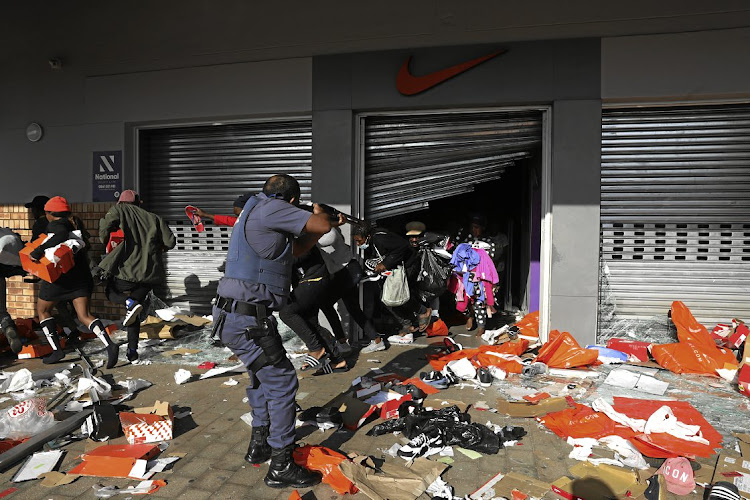
The increasing reliance on surveillance technology reflects lessons learnt from the July 2021 unrest, which left more than 300 people dead, crippled supply chains and caused billions of rands in economic losses.
“This should be a very good test of this type of equipment for future reference,” Thomas said. “It would have been exceptionally useful during the July 2021 unrest if police had qualified drone operators and greater access to surveillance technology.”
The June 30 protests have also prompted unprecedented cooperation between the police and private security companies. On June 26, Acting Police Minister Firoz Cachalia met representatives from the private security industry to strengthen collaboration ahead of the demonstrations.
According to the Ministry of Police, the meeting focused on improving information sharing, coordinated planning, and technology resource pooling between the public and private sectors.
True scale demands moving beyond surface-level integrations to robust execution. We’ve filtered the noise out of Moonshot 2026, optimising the conference strictly for high-calibre connections between startup founders, global financial operators, enterprise leaders and individuals rewiring Africa’s technical frameworks.
Get 20% off Early Bird tickets for a limited time.