

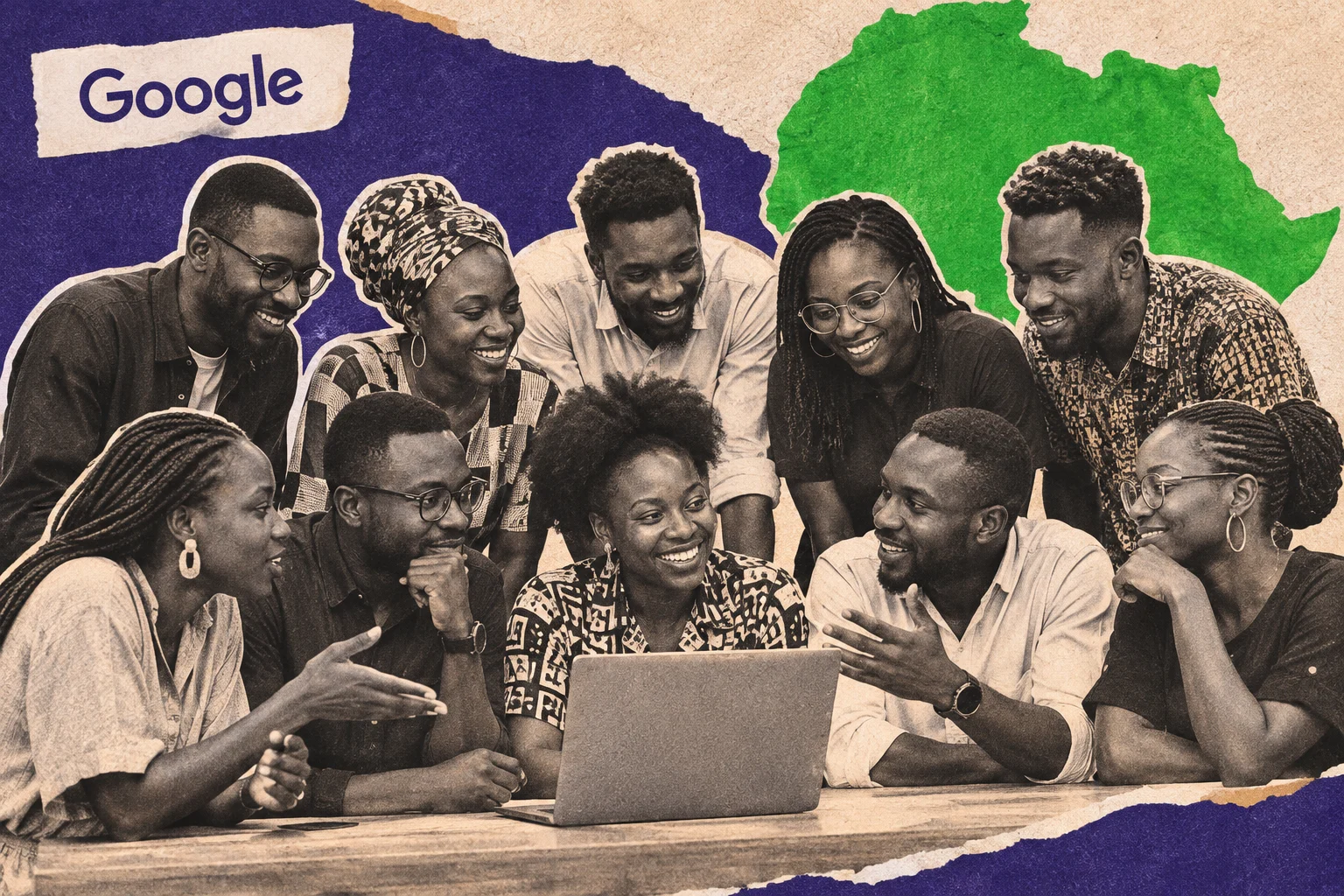
Google has named the ten companies joining the first cohort of its Africa Applied AI Lab, turning a programme announced earlier this year into a concrete list of African products and founders. The group spans healthcare, agriculture, identity, payments and customer support, with several teams working around a familiar constraint: useful AI must reach people in local languages and on the devices they already own.
The official announcement, published on 11 November, says the startups will receive early access to Google AI models and work with its engineers, researchers and product leaders. The programme is managed by Google’s AI Futures Fund alongside Google Research. Four venture firms will provide guidance on bringing products to market. Google did not disclose a cash grant or investment amount for each selected company, so the cohort should not be described as ten funded deals of a known size.
Nigeria is strongly represented. Intron builds speech recognition for clinical and enterprise use that can handle African accents and code-switching. Termii provides customer verification, messaging and operational alerts for financial services, while Vendy helps businesses sell and accept payments inside WhatsApp. Each addresses a different piece of the challenge of making digital services work in a market where language, messaging platforms and customer trust shape adoption.
Elsewhere, Uganda’s Crane AI Labs develops offline AI tools for health workers and schools on affordable phones. Kenya’s Satlyt aims to process data on connected satellites. Senegal’s Tolbi combines satellite imagery with voice guidance for farmers. The pan-African companies are AethexAI, which makes voice agents for customer support; Agrails, which is building insurance infrastructure; Smile ID, which uses computer vision for identity checks; and Viamo, which makes AI available through basic phone calls in local languages.
The range is the story. Some founders are building infrastructure for businesses; others are trying to deliver a service to people who may have limited connectivity or no smartphone at all. A model that performs well on a benchmark is only one component. Speech accuracy across accents, operation on low-cost hardware, responsible handling of medical or identity data and a sustainable route to customers will determine whether these systems work beyond a demonstration.
Google says it received thousands of submissions from more than 45 African countries before selecting the ten. Over the coming weeks, the teams will work with models including Gemini and Gemma. Google names 4DX Ventures, Norrsken22, Novastar Ventures and Ventures Platform as venture capital partners providing commercial guidance. The cohort is due to meet in Accra in December for a demo day, where investors and other industry participants can see what the startups have built.
Selection is valuable, but it is not proof that every product will scale or that Google has solved the economics of African AI. Founders still face computing costs, data quality problems, regulation, distribution and the need to earn revenue. Some applications, particularly health and identity services, also require careful testing and safeguards before people can depend on them.
The lab fits a wider push to give African teams more than an invitation to use models designed elsewhere. TechBooky has reported on the UNDP and GSMA effort to support African-led AI, which likewise puts language, computing access and real deployments at the centre of its plans. Google’s cohort offers a different test: whether close technical support and model access can help ten existing businesses improve products people already have reasons to use.
The next useful evidence will come from product results, not the selection announcement alone. At the Accra showcase and afterwards, founders should be able to show what changed in accuracy, cost, reach or customer adoption because of the lab. That is how this first cohort can be judged as an applied AI programme rather than simply another list of promising startups.
