

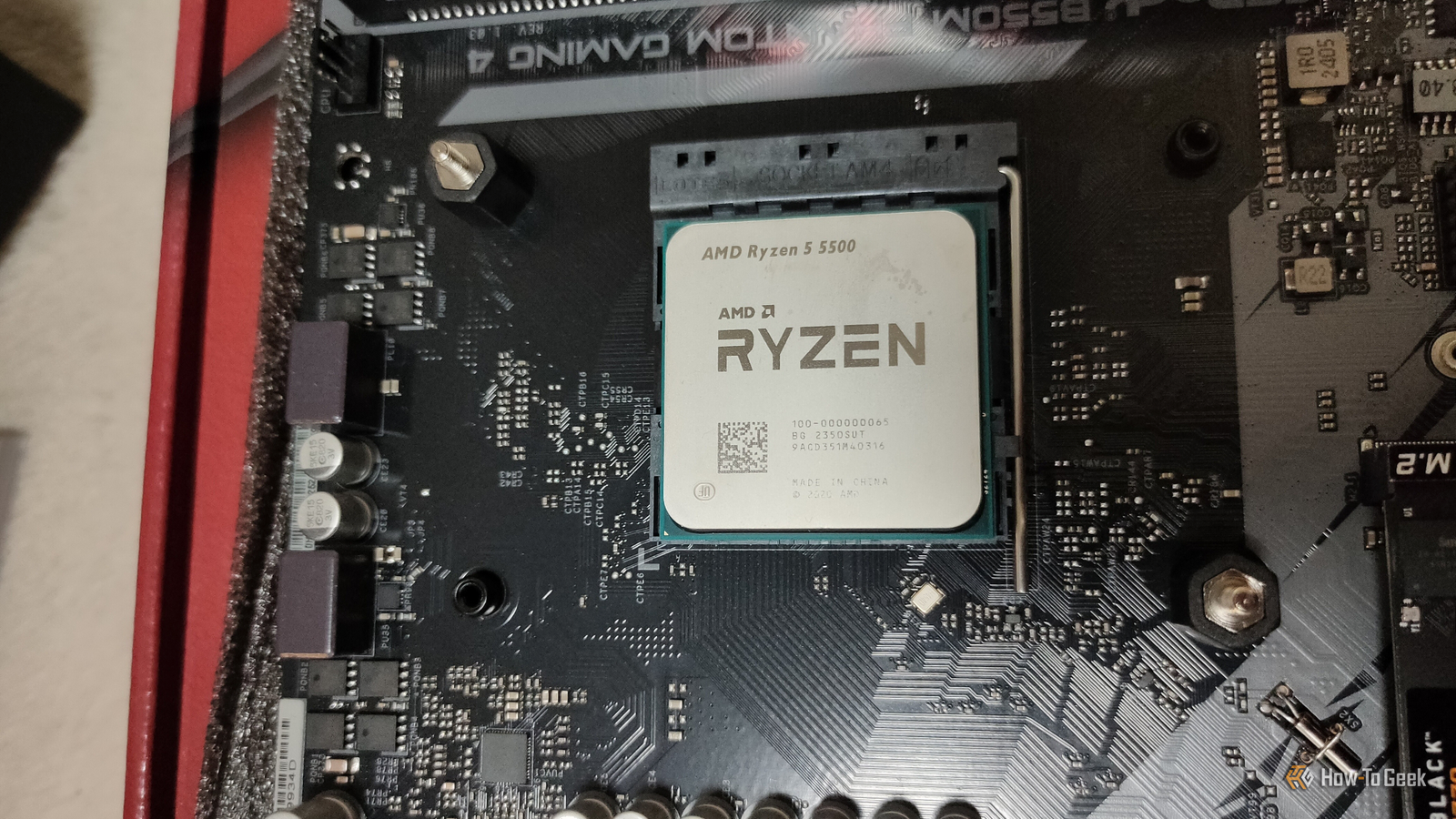
AMD’s AM4 platform is now a decade old, but it remains a popular choice among budget PC builders. New AM4 CPUs are still readily available, and since AM5 motherboards and DDR5 memory have now become prohibitively expensive, sticking with the older platform is now the only way to build a PC on a budget.
One particularly popular choice is the Ryzen 5 5500, which is often one of the cheapest new Ryzen 5000 Series processors available at retail. Its name makes it sound like a slightly slower version of the Ryzen 5 5600, but the two are far more different than you might expect. They don’t even use the same silicon design, and the compromises AMD made with the 5500 make it a considerably less appealing purchase.
It’s easy to see why the Ryzen 5 5500 is so popular among budget builders
Six cores and twelve threads for less than $100 sounds like a great deal
On the surface, the Ryzen 5 5500 appears to be an extraordinary deal. It’s a 6-core, 12-thread CPU built on TSMC’s 7nm process that boosts up to 4.2GHz, has a TDP of just 65W, and is unlocked for overclocking, all while costing less than $100.
For a basic desktop PC that handles everyday multitasking, office apps, multi-tab web browsing, and light photo and video editing, it’s all you could really ask for. It even supports hardware virtualization for running virtual machines. The Ryzen 5 5500 is also a pretty popular CPU for 1080p budget gaming builds. Spending less on the CPU opens up your budget for a pricier graphics card, which can generally net you more FPS per dollar than spending more on the processor in GPU-bound games.
You can pair this cheap CPU with an inexpensive AM4 motherboard like the Gigabyte B550M K and 16GB of DDR4 RAM to get yourself a pretty solid starter kit for around $300. But given how cheap the Ryzen 5 5500 is new and the fact that it’s not a 4-core chip, the question you should really be asking is: what compromises did AMD make to get it there?
The Ryzen 5 5500 and 5600 are far more different than their names suggest
The two processors use completely different silicon

Just by looking at their names, the Ryzen 5 5500 and 5600 appear to be similar CPUs to the average buyer. A lower number often indicates a lower-tier model, just as the letter X typically indicates a higher-performance one, right?
While that might be true for some CPUs like the Ryzen 7 5700X and 5800X or the Ryzen 5 7500F and 7600, it’s not the case at all here — the Ryzen 5 5500 uses a different silicon design from the Ryzen 5 5600 and other mainstream Ryzen 5000 Series chips.
Both are based on Zen 3, but while the Ryzen 5 5600 uses the Vermeer chiplet design, the Ryzen 5 5500 is based on the monolithic Cezanne design. Cezanne was used for AMD’s APUs with integrated Radeon Vega graphics, like the Ryzen 5 5600G and Ryzen 7 5700G. While those chips are great for PCs that don’t use a dedicated graphics card, their design comes with some serious compromises that the Ryzen 5 5500 inherits.
The two major downgrades are the Ryzen 5 5500’s PCIe 3.0 support and 16MB of L3 cache, compared to the Ryzen 5 5600’s PCIe 4.0 support and 32MB of L3 cache. The smaller cache can hurt gaming performance, especially in CPU-intensive games, and can also lead to worse 1% lows with less consistent frame times.
The other major downgrade, the lack of PCIe 4.0 support, is a much worse trade-off than you might think. Aside from newer NVMe SSD speeds being bottlenecked, the graphics card can take a real performance hit because of this. Many people with the Ryzen 5 5500 are building on a budget and typically combine it with a budget graphics card.
The problem is that some modern AMD and NVIDIA graphics cards use fewer PCIe lanes, relying on the higher bandwidth of PCIe 4.0 and 5.0 instead of the full 16 lanes that higher-end GPUs use. Some examples of cards that can suffer from the reduced PCIe bandwidth include:
- Radeon RX 6500 XT (PCIe 4.0 x4)
- Radeon RX 6600/6600 XT/7600 (PCIe 4.0 x8)
- GeForce RTX 4060/4060 Ti (PCIe 4.0 x8)
- RTX 5060/5060 Ti (PCIe 5.0 x8)
The performance hit can be more drastic than you’d expect. In TechSpot’s 10-game average tests, the Ryzen 5 5500 delivered around 24% lower average FPS and 30% worse 1% lows than the Ryzen 5 5600 when paired with an RTX 5060. The only modern card that won’t get completely devastated by that PCIe 3.0 x16 slot is the 16GB variant of the RX 9070 XT, although the Ryzen 5 5500 is still going to be a significant CPU bottleneck.
Tell XDB what you want the PC to do and how much you want to spend. We’ll find parts that
fit, with current prices.
What will you use it for? Pick any
Budget
Pick at least one use, or name a game or app.
There are much better ways to spend your money on an AM4 processor
You don’t have to spend much more to get something considerably better

Hopefully, you can now understand why the Ryzen 5 5500 costs as little as it does. It sacrifices L3 cache and drops PCIe support to version 3.0, which can limit the performance of certain graphics cards and make it generally harder to live with, particularly for gaming. The good news is that if you’re willing to spend just a little more, you can get a more capable AM4 CPU with fewer limitations.
The most obvious choice is the Ryzen 5 5600, but it typically costs around 50% more new. A used or refurbished Ryzen 5 5600 can sometimes be found at a price much closer to that of the Ryzen 5 5500, so try shopping around. The Ryzen 7 3700X is another solid option if you’re willing to buy used. It’s an older-generation chip with slower single-core performance, but it supports PCIe 4.0 and has 2 more cores and double the L3 cache, giving it an edge in more heavily multithreaded workloads.
But perhaps the best alternative to the Ryzen 5 5500 is the newly released Ryzen 5 5500F, which is based on Vermeer silicon and has more in common with the Ryzen 5 5600. It still has just 16MB of L3 cache, but it has a 0.2GHz higher boost clock and supports PCIe 4.0, all while costing only around $15 more than the Ryzen 5 5500 at the time of writing. I’d pick it up over the Ryzen 5 5500 in a heartbeat.
The Ryzen 5 5500 is fine as long as you know what you’re getting
Look, if you’ve already bought the Ryzen 5 5500, I’m not here to make you feel bad about your purchase. It’s a “you get what you pay for” situation, and the Ryzen 5 5500 is ultimately one of the cheapest new 6-core AM4 CPUs on the market. It’s still a 6-core, 12-thread processor that makes a fantastic alternative to many faster 4-core CPUs in heavily multithreaded workloads.
In fact, for the right price, I think that the Ryzen 5 5500 is a pretty sensible purchase. It’s occasionally gone on sale for as little as $70, and it comes with a decent stock cooler, making it excellent value for an all-rounder build. Just keep your expectations realistic.
