

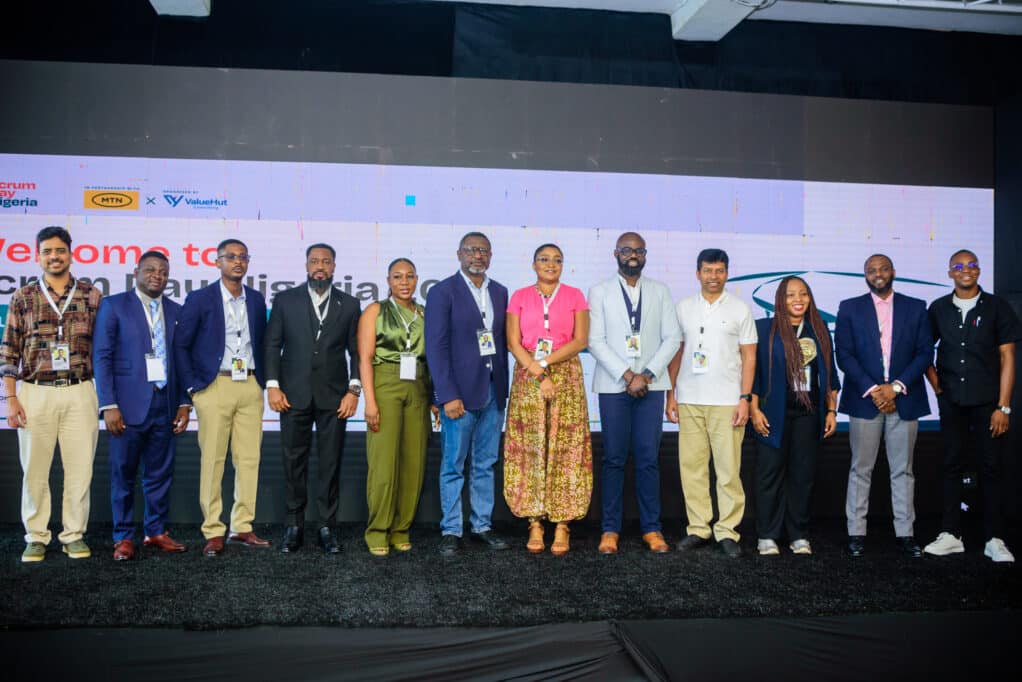
Industry leaders have identified culture, quality practices, and the responsible use of artificial intelligence (AI) as central factors shaping product development in Nigeria, as discussions at Scrum Day Nigeria 2026 highlighted how organisations can deliver better outcomes in a changing environment.
The event, held in Lagos under the theme “Building Better Products—Sooner, Safer and Happier”, brought together professionals across technology, finance, and consulting to examine how agile frameworks such as Scrum can improve delivery, collaboration, and long-term value.
Effective collaboration takes centre stage at Scrum Day Nigeria
Convener of the event and Managing Partner at ValueHut Consulting, Sam Adesoga, explained that Scrum, a framework originally rooted in software development, enables teams with diverse skill sets to collaborate effectively and deliver on shared goals.
He noted that while organisations often prioritise speed, this can come at the cost of quality and employee wellbeing, leading to burnout, disengagement and reduced efficiency over time. According to him, the goal is not simply to move fast, but to build systems that allow teams to deliver consistently without compromising standards or people.
Adesoga highlighted that adoption in Africa remains relatively slow compared to regions such as the United Kingdom, the United States, and Europe, where the framework has matured and become widely embedded across sectors. He attributed this gap partly to cultural dynamics, particularly hierarchical workplace structures common in Nigeria, where junior employees may feel unable to question authority or challenge decisions openly.
He stressed that while these cultural nuances pose real challenges, they are not insurmountable barriers. Rather, they require deliberate adaptation, strong facilitation, and skilled Scrum practitioners who understand how to align global frameworks with local realities without losing effectiveness.
Responsible use of Artificial Intelligence
On trends that will shape product development in the future, he pointed to artificial intelligence as a major force, cautioning that while AI can accelerate processes and improve efficiency, it must be integrated responsibly. He warned that an over-reliance on speed driven by AI could lead to the development of unsafe products or systems that fail to meet user needs.
He added that AI’s growing appeal could also encourage longer working hours and increased pressure on teams if not properly managed, raising concerns about sustainability and workforce wellbeing.
Principal Product Owner at Gopaddi, Jeremiah Odey, emphasised that planning alone is insufficient for business success, arguing that organisations must build repeatable systems that enable consistent execution and long-term growth.
He said companies that rely solely on planning risk, mistaking short-term success for sustainable progress, noting that without clear systems, outcomes may not be reproducible.
According to him, structured processes are what enable organisations to move from ideation to product delivery and then repeat that cycle effectively. He explained that systems create stability, allowing businesses to scale without losing control of quality or direction.
Odey also identified AI as a dominant trend in the coming years, particularly with the rise of agentic systems capable of handling tasks across multiple stages of product development. While acknowledging concerns about job displacement, he said his organisation has chosen to retain its workforce while leveraging AI to improve productivity.
Rather than replacing roles, he said AI is being used to expand capacity, allowing teams to achieve more within shorter timeframes while maintaining output quality.
Drivers of Innovation
General Manager of Architecture and Engineering at MTN Nigeria, Bukola Ajayi, stressed the importance of leadership buy-in in driving successful transformation initiatives within organisations.
She noted that adopting Scrum within the company improved collaboration between business and technology teams and significantly reduced time-to-market. She added that while early implementation efforts included setbacks, those experiences provided important lessons that shaped future improvements.
According to her, investing in training, continuous learning, and open communication played a key role in ensuring adoption across teams. She also highlighted the importance of creating an environment where teams are allowed to experiment, fail early, and learn quickly without fear.
Principal Consultant at DKO Consulting, Dolapo Otegbayi, challenged common perceptions about innovation, stating that it is less about creativity and speed and more about navigating real-world constraints such as cost, risk, consumer behaviour and scalability.
She warned that many organisations rely on assumptions rather than validated consumer insights, leading to products that fail in the market despite internal confidence and optimism.
According to her, true innovation requires disciplined decision-making, strong alignment across departments, and a willingness to confront failure early in the development process. She stressed that market realities, not internal strategies or leadership assumptions, ultimately determine product success.
Agile Solutions Practice Centre Head at Sterling Bank Plc, Abimbola Babalola, underscored the need to embed quality thinking throughout the software development lifecycle, stressing that quality should not be treated as a final checkpoint but as a shared responsibility across teams.
He noted that cultural and contextual understanding plays a critical role in product success, citing instances where products failed because they did not align with local realities or user expectations.
Babalola argued that every team member must act as a quality advocate by continuously questioning the relevance and usefulness of features being developed. He added that constructive disagreements and moments of discomfort within teams can drive innovation and lead to better outcomes when properly managed.
He further explained that quality assurance goes beyond testing, encompassing the need to ensure that products truly meet user needs and expectations. According to him, there is a clear distinction between quality assurance as a process and quality thinking as a mindset that must be embraced collectively across all levels of an organisation.
As discussions at the event showed, the future of product development in Nigeria will depend not only on adopting new tools and frameworks, but also on how well organisations balance speed with quality, adapt to cultural realities and integrate emerging technologies responsibly.
