

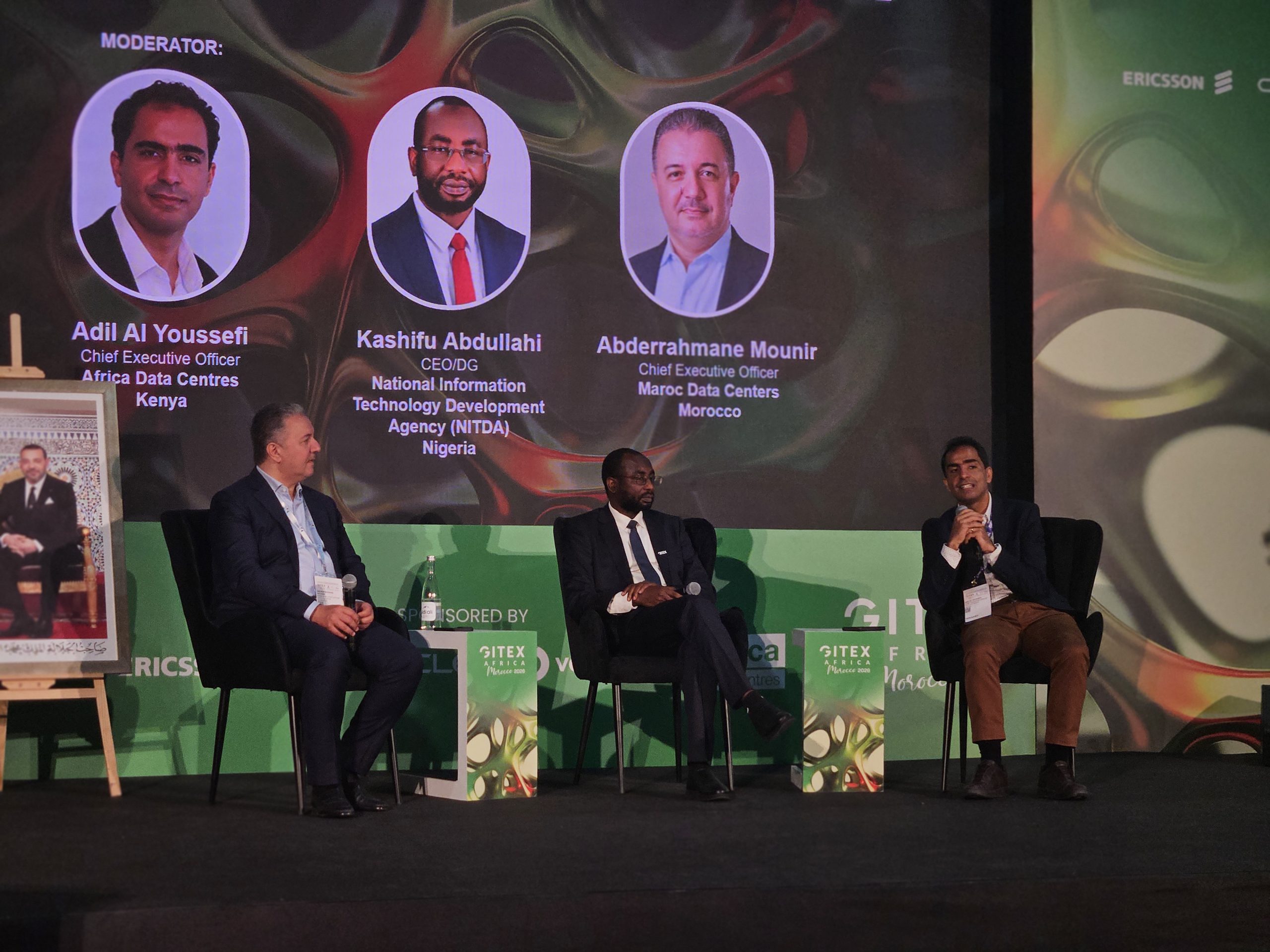
I sat in on a cloud panel at GITEX Africa in Morocco on April 8, 2026, that was less about how countries and companies are adopting the cloud, but more about who is controlling it.
The session, themed ‘Africa’s Cloud Moment – Build Regional or Stay Fragmented,’ brought together Kashifu Abdullahi, director-general of Nigeria’s National Information Technology Development Agency (NITDA), and Abderrahmane Mounir, chief executive officer, Maroc Data Centers, Morocco. The session was moderated by Adil Al Youssefi, CEO, Africa Data Centres Kenya.
“If digital is a lifestyle to us, then cloud is the oxygen to sustain it,” Abdullahi said. “We need to own and shape and control the oxygen to sustain our lifestyle.”
Africa has about 19% of the world’s population. Abdullahi highlighted that it only had 0.6% of the global data center and computing capacity.
“We do not control our own digital future. We cannot survive without the cloud; we need to cloudify Africa. But nobody can do it for us; we need to do it ourselves,” the NITDA boss stated.
The fragmentation problem
The conversation about cloud sovereignty can quickly slip into protectionism, where governments push to keep data within their borders, favour local providers, and limit the role of foreign cloud companies in the name of control. Abdullahi argued that digital self-determination is more important.
“It is about us as a sovereign continent having the capacity for digital self-determination. Therefore, we need to work together,” he said.
Mounir argued that if every country tries to achieve self-sovereignty, it will come at a cost that can’t scale.
“There is an economic challenge to build this fragmented cloud all around the country,” he said. “The effort needs to be done in as many countries on the continent.”
Navigating the continent’s macroeconomic challenges is crucial to harnessing the potential of the digital economy, and the only way to do that is to build together, Youssefi noted.
Demand for data centre capacity on the continent is expected to rise to two gigawatts by 2030, requiring at least $10 billion in investment, according to projections from McKinsey, a global management consulting firm.
Currently, the combined installed capacity of the continent’s top five markets (Egypt, Kenya, Morocco, Nigeria, and South Africa) is under 500 MW, less than what France had in 2024 (about 800 MW).
“Fifty-four African countries cannot build individually. But we also cannot import the solutions from outside. We have to craft our own solutions there,” Youssef said.
The building ambition
Abdullahi referenced Gaia-X as a template for the continent.
The European Union launched Gaia-X in 2020, an initiative that aims to build an interoperable, secure data infrastructure that complies with its standards.
The strategy aims to strengthen the EU’s digital sovereignty in the face of the hegemony of North American players.
America’s Amazon AWS owns 28% of the global cloud market, followed by Microsoft’s Azure at 21%, and Google Cloud at 14%.
In the fourth quarter of 2025, global cloud infrastructure service spending grew to $119 billion, and thanks to the AI boom, the cloud market is expected to keep growing year-on-year.
Africa has the Smart Africa Trust Alliance, a cross-border data exchange guideline. The African Continental Free Trade Area also has protocols for digital trade. But experts had noted that the implementation has yet to meet its ambition.
“We need to build digital highways between African countries so that we can start creating and capturing value from the data we are creating,” NITDA’s boss said. “We need to look at all those regulations and policies.”
Owning the cloud will also entail harmonising data laws.
“If you want to push things across the borders, there is the regulation aspect that also has to be cross-border, with all the concepts of data indices to give guarantees and to basically harmonise the regulation between countries,” Mounir said.
So, who builds?
Shared cloud infrastructure will continue to remain a dream without execution, Youssefi said.
On who should take the lead, Abdullahi noted that both the private and public sectors have roles to play. The government has regulatory roles, while the private sector has capital expenditure expectations.
Mounir noted that governments must put their skin in the game.
“They need to put a piece of investment. That is how it is going to work. It is to have an anchor within the country, to have some sort of institutional investor,” he said.
Much of the cloud infrastructure on the continent is currently private sector-led.
MTN Nigeria completed the first phase of its $235 million data centre and cloud infrastructure in 2025.
Cassava Technologies has launched Africa’s first AI factory in South Africa, where it is deploying thousands of GPUs, Youssefi said.
“A couple of thousand GPUs is a drop in the ocean, as we said briefly earlier, compared to what is required across the continent for us to reach the ratio of one in five that we have at the macro level,” he said.
Failure to act now will keep Africa out of the fourth industrial age, NITDA’s boss argued, especially with rising AI deployment making the ownership of cloud infrastructure expedient.
“We know that who owns our data controls us,” he added.
