

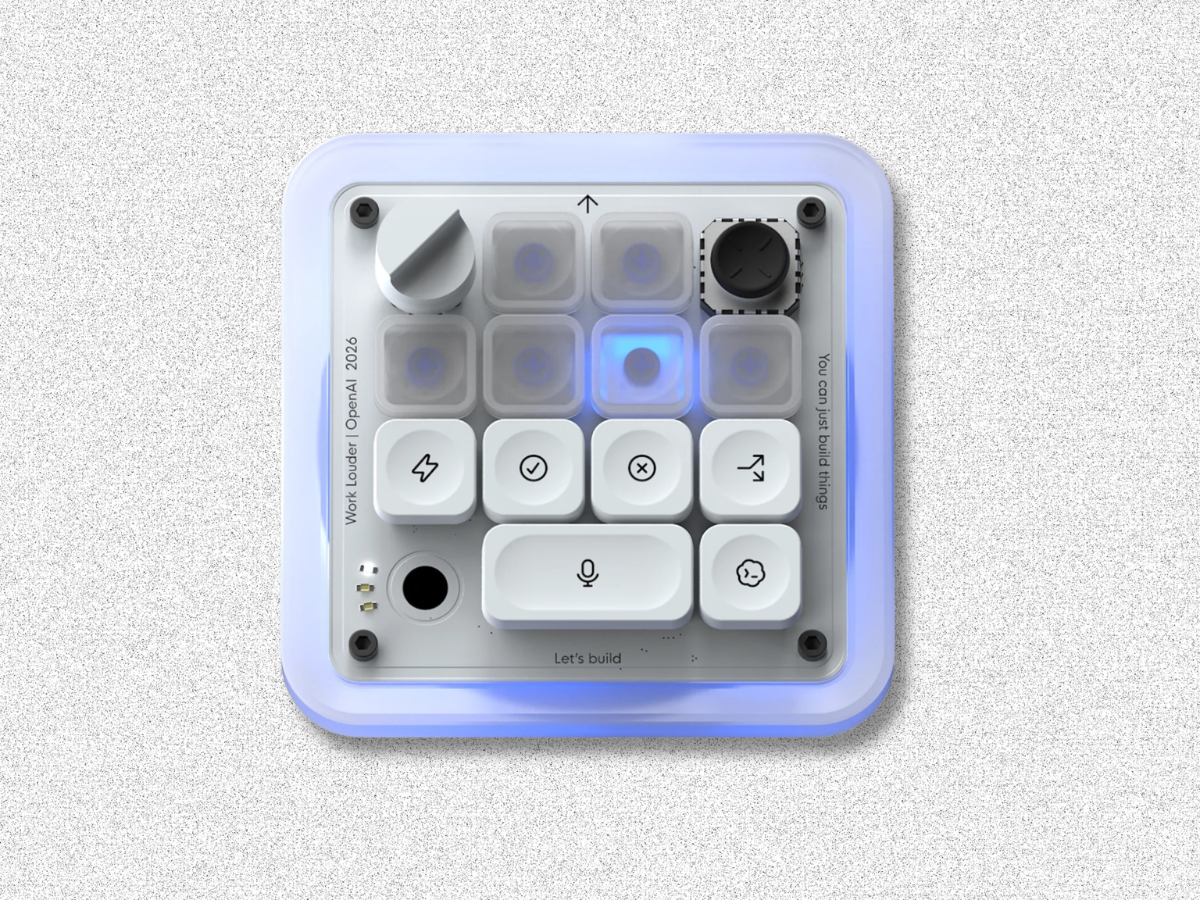
OpenAI has introduced the Codex Micro, its first hardware product aimed at consumers. Priced at $230, it is a mechanical keypad designed for use with OpenAI’s Codex coding agent.
The device was developed with assistance from the team at Work Louder and includes 13 mechanical switches, a touch sensor, a rotary dial to adjust reasoning levels, and an analog stick.
Pre-orders are currently available, with the first units expected to ship later this month. OpenAI describes the accessory as a limited-run product.
The Codex Micro is not the screen-free AI device that OpenAI is developing with former Apple designer Jony Ive. Instead, it is a separate hardware product focused specifically on improving coding workflows.
Inside the Codex Micro: Features, Inputs, and Connectivity
The keypad offers a variety of customizable inputs, including 13 mechanical switches, a touch sensor, a rotary dial for adjusting the reasoning level on the spot, an analog stick, and integrated RGB lighting for alerts and notifications. It also comes with multiple dozen extra keycaps for further personalization.
All inputs can be tailored to suit individual workflows. The rotary dial, which adjusts the Codex reasoning level, is a notable feature, allowing users to set the AI’s level of computation directly from the hardware rather than through software settings.
The RGB lighting serves purposes beyond visual appeal. It is used to indicate different alerts and notifications, such as when the AI has completed a task or needs input.
The Codex Micro provides Bluetooth and USB-C connectivity, making it compatible with both Windows and Mac. The dual connectivity options give users the choice of a reliable wired connection or a wireless setup that keeps the workspace cleaner.
Codex Micro Pricing, Limited Run, and Value for Developers
The Codex Micro is priced at $230. Pre-orders are now available on OpenAI’s website, with the first units expected to ship later this month.
OpenAI described the accessory to TechCrunch as more of a limited-run project, suggesting it may not be available for long after the launch. Those interested should consider placing a pre-order soon, as the limited supply could affect availability.
The $230 price has received some criticism, with questions raised about whether it’s justified for what is essentially a device with a few customizable inputs. Its value largely depends on individual workflows:
For developers who frequently use Codex, the physical controls and reasoning dial could help save time by reducing the need to switch contexts. For casual users, the price may be harder to justify given the number of inputs offered.
The productivity benefits increase with how often a user depends on Codex in their daily tasks.
Similar to a Stream Deck, the Codex Micro functions as a specialized productivity tool. Its usefulness largely depends on how often it is used and how much it helps streamline repetitive actions.
Should You Buy the Codex Micro and What It Means for OpenAI Hardware
For developers considering the Codex Micro: assess how often you use Codex in your workflow, since its value depends on usage.
Think about whether physical controls for the reasoning level and common actions would improve your experience. Keep in mind that the product is limited in availability, which means it might not stay on the market or receive long-term support.
Compare the price to alternatives like configurable macro keypads or the Stream Deck, which can be programmed for similar tasks at different price points.
For casual users, the peripheral is unlikely to justify its cost, as general-purpose macro keypads offer similar physical input customization at a lower price, but without the Codex-specific features like the reasoning dial.
The Codex Micro launches amid OpenAI’s broader hardware initiatives and ongoing legal issues. Last year, OpenAI announced a partnership with Jony Ive to create a screen-free AI device with multiple cameras and sensors for spatial awareness. That device is separate from the Codex Micro and has not yet been released.
OpenAI is also facing a lawsuit from Apple, which claims that former Apple employees stole trade secrets to develop OpenAI’s hardware products.
The Codex Micro, developed with Work Louder rather than Jony Ive’s hardware team, appears to be outside the scope of that dispute.
The launch also fits into the broader trend of AI companies expanding into hardware. As competition increases among OpenAI, Anthropic, Google, and Meta, physical products that tie users into specific AI ecosystems could become a differentiator, though the limited-run status of the Codex Micro suggests it is more of an experiment than a permanent product line.
The Codex Micro is available for pre-order from OpenAI’s website at $230. The first units are expected to ship later this month. Due to its limited run, OpenAI has not committed to ongoing availability or restocks.
Those interested should pre-order promptly. The company has not announced international shipping, warranty terms, or long-term software support. Users should watch OpenAI’s channels for updates as the shipping date nears.

