


What if you could escape your real life and rebuild it from scratch? For millions of Nigerians playing Lagos Life, Lagos Run and other viral games, the attraction is not just entertainment. It is the chance to become a billionaire, own property, run businesses, meet people and experience a version of Lagos where there is always a reset button. For some players, it is an escape from financial pressure. For others, it is nostalgia, social connection or simply the thrill of turning everyday Nigerian struggles into a game. But why are people spending hours inside these digital versions of home? ADEOLA OLATUNJI and JOHN ADOYI spoke to players across different walks of life to find out.
When the household falls quiet in Abeokuta, Esther Igwe turns to her phone screen to live a completely different life.
By day, she is a customer care representative, a karaoke host, and a nursing mother grappling with the compounding financial anxieties of post-National Youth Service Corps life in Southwest Nigeria. By night, she is a multi-company mogul and a virtual trillionaire.
Esther does not fit the typical profile of a gamer; before this, her mobile play was strictly limited to Scrabble and word puzzles. But when her group chat began buzzing about Lagos Life—a free browser-based simulation—she found something far more urgent than casual entertainment.
“It is a form of escape from reality for me,” she says plainly. “I use it to escape from all the stress and worries of my current reality—of being broke and having nothing.”
Inside her digital dashboard, Esther has acquired assets that remain out of reach offline: commercial real estate, corporate entities, and a balance sheet holding over ₦1 trillion ($751.86 million) in virtual currency.
“I am playing to see what my life would actually look like if I had that kind of money in real life,” she adds.
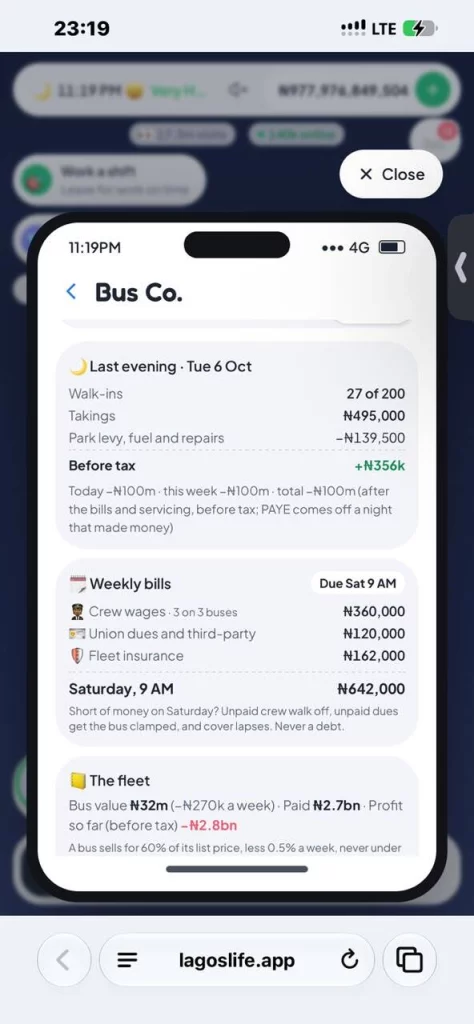
Esther is part of a massive, quiet migration of young Nigerians seeking refuge inside digital playgrounds that mirror their own backyards.
Over recent weeks, titles like Lagos Run and Lagos Life have swept across social feeds. Lagos Run, an endless runner created by Opeyemi Adeniran, places players behind the wheel of an iconic yellow danfo bus—dodging gridlock, picking up commuters, and collecting coins. It crossed 20,000 players within 48 hours of release.

Lagos Life, launched on October 1, 2026 by developer Shalom Rayhamen, took the trend further.

A multiplayer text-and-strategy simulator where players navigate jobs, rent, relationships, and property markets, it drew over one million users within its first three days.
Yet while virality explains how quickly these games spread, it does not explain why players refuse to log off.
A Lagos that feels familiar
Afunwape Temitope, currently looking for a job after her mandatory NYSC for Nigerian graduates, discovered Lagos Life on Snapchat.
At the time, screenshots of players whose virtual characters had gone broke were circulating online. The memes were funny, but what convinced Temitope to sign up was how closely the game resembled the chaos of actual life in Lagos.
Although the game’s language felt deliberately Nigerian, her first reaction was laughter. From choosing between starting life as a “Nepo baby” (used to describe someone who achieves success or fame largely due to the influence, wealth, or connections of their famous parents) or a “Lapo” (used to describe a person who grows up in working-class or impoverished conditions with Little Access to Privileges and Opportunities) to the daily struggle to keep a character healthy and happy while finding enough money to survive.
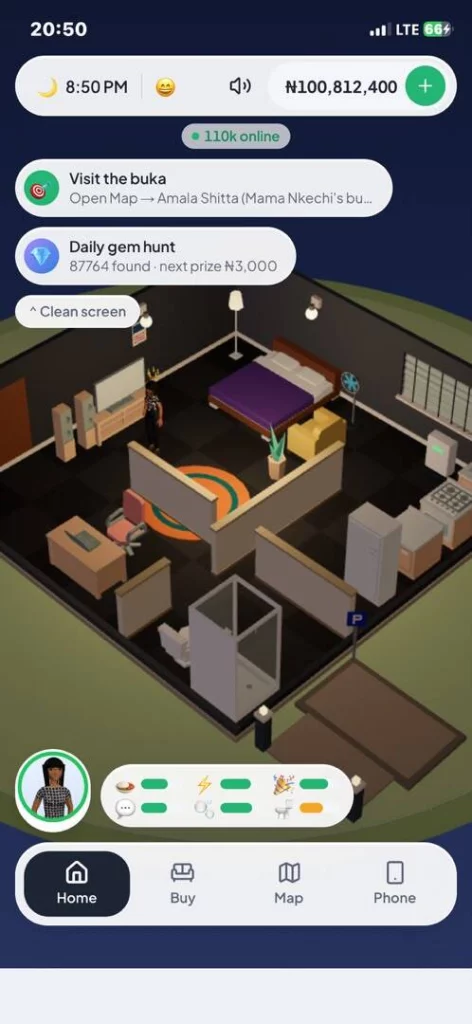
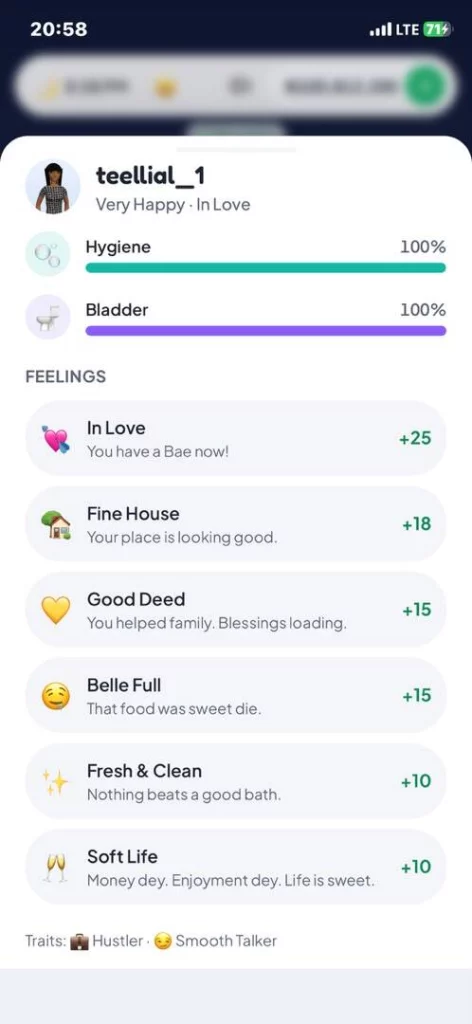
A typical day for Temitope now involves searching for better-paying jobs while trying to meet her character’s needs. She spends about two or three hours a day playing, usually during breaks or before bed.
“It feels less like a basic text game and more like a funny, high-stakes strategy game where I genuinely want to see if you can break out of poverty,” she said.
In Lagos Life, players deal with landlords, unexpected expenses, power-related problems, “black tax,” and the pressure to balance a main job with side hustles. The game’s official description can be interpreted as a fictional entertainment experience inspired by everyday Nigerian life, including employment, finance, property, relationships, transportation, and social activity.
For Temitope, that familiarity separates Lagos Life from other games.
“Other games feel disconnected because the scenarios were based on Western realities,” she said. “But Lagos Life offers cultural context.”
There is also one crucial difference between her virtual and real life.
“In the game I can hit restart,” she said. “In real life, no reset button.”
That distinction may just be part of the appeal.
The illusion of balling
Kheezran, a student at the University of Ibadan, Oyo State, southwest Nigeria, who plays Lagos Life, discovered it on X. She says what she enjoys most is the opportunity to experience things that are currently beyond her means.
She plays for three or four hours on average, though each session lasts less than 20 minutes.
For her, Lagos Life is partly entertainment and partly an opportunity to understand how money works. She also sees it as an escape.
Ademola Johnson, a network engineer in Ibadan, approached the game differently.
He initially spent around four hours a day or more playing Lagos Life. He enjoyed interacting with other Nigerians rather than only computer-controlled characters, and the game made him “feel like a kid” again.
His virtual wealth quickly became part of the fun.
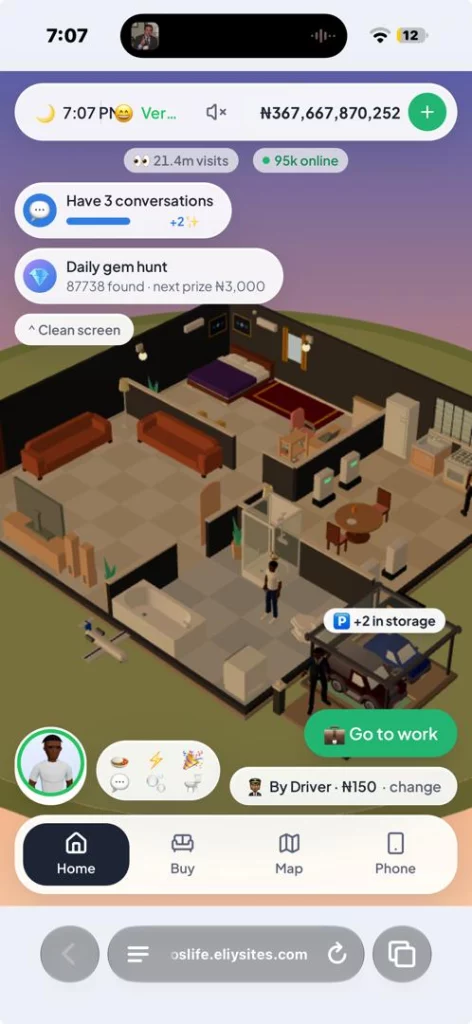
He bought land in Banana Island and Lekki, two cars, and a house or mansion in Banana Island. He even hired people to act as his virtual pet.
But the novelty eventually wore off as Ademola has now stopped visiting the game. He believes Nigerians move very fast and thinks Lagos Life may be a passing trend.
Oduyemi Elijah, a brand and motion designer in Abeokuta, has had the opposite experience.
He spends three to four hours a day playing Lagos Life and says he enjoys the game’s money system most. He has accumulated more than ₦100 billion ($75.14 million) in virtual money and spends it on cars, company setups, giveaways, clubbing, food and groceries.
He says he plays for entertainment, escape, social interaction and the possibility of making money.
“I feel so much alive if I am on it,” he said.
For Oduyemi, the game also helps clear his head. The money is not real, but the feeling of having it can still be satisfying.
Victoria Eke, a broadcaster in Cross River State, describes that feeling more directly. She sees Lagos Life as an escape from the financial pressures of everyday life, where players can temporarily experience a version of wealth that may be out of reach offline.
“If you can’t be a baller in real life, you be a baller in Lagos Life,” she said.
Eke first heard about the game from a friend and started as a “Lapo baby”. She has since accumulated about ₦9.7 billion ($7.29 million) in virtual money. She also works at a virtual radio station, where she earns ₦11,700 ($8.80) an hour in the game.
“You might not have money with you physically,” she said, “but you could literally be a billionaire in the game.”
For Eke, the attraction goes beyond the money itself. She has met other players through the game, exchanged Instagram handles and continued conversations with some of them outside the platform.
“You build steady connections,” she said.
But she also thinks the same qualities that make Lagos Life compelling can make it easy to spend too much time playing. She does not play every day, but whenever she has free time, she finds herself returning to the game.
“The game can be very addictive,” she said. “If you’re not careful, you can spend a whole day on it.”
Lagos Life’s terms make clear that its in-game naira, properties, jobs and other items have no real-world value and cannot be cashed out, sold or transferred outside the game. That means the wealth players accumulate is ultimately part of the fantasy, but that has not stopped them from investing hours into building it.
Low friction and ultimate irony
One reason these games have travelled so quickly may be that they ask very little of the people playing them.
Lagos Run can be opened in a browser and played immediately. Lagos Life also runs in a browser rather than requiring users to download a conventional mobile game like many are used to.
But accessibility alone does not explain why people keep returning. One important thing to note is that the games are recognisable. They take experiences that Nigerians already complain about and make them playable.
That matters for Esther, who is juggling motherhood, work and other responsibilities.
She does not play Lagos Life because she wants to compete with other players or meet people online. She is not particularly interested in the social side of the game. She plays because, for a few hours at night, she can build a life that looks very different from her own.
As for how long the fascination will last, Temitope is sceptical about that.
“I believe the hype around it will reduce very soon because people will remember that they need to feed and live real life,” she said.
She does not know how long she will continue playing.
“At the end of the day, it is just a game actually.”
A passing trend?
The speed at which these games have grown suggests that something is happening beyond just a few viral posts.
For these players and many more, the appeal differs. It is either partly aspirational escapism, entertainment and the feeling of being temporarily wealthy, social interaction and the nostalgia of simply feeling like a kid again, or the pleasure of seeing everyday Nigerian problems turned into something one can laugh about.
Eke sees a common thread running through those experiences. She says it is the desire to temporarily inhabit a life that feels better than the one outside the screen.
“Everybody wants to be a baller,” she said. “So, if you can’t be a baller in real life, you be a baller in Lagos Life,” she said. Adding that people need to be careful to avoid being addicted.
The games are not necessarily replacing social media, work or real-life relationships. None of the players interviewed said they had abandoned their existing social circles because of them. Instead, the games have found a small space inside the lives people already have.
And for people whose real lives are constrained by money, mobility or circumstance, the appeal of a virtual world may be less about pretending reality does not exist than about temporarily controlling a version of it.
The irony is that the games Nigerians are escaping into are built from the same reality they are trying to escape. There are landlords in Lagos Life, bills, unemployment, “sapa” and, of course, the hustle.
But there is also money, status and the possibility of becoming a billionaire, even if only on a screen. And for now, that may be enough to keep people coming back.
True scale demands moving beyond surface-level integrations to robust execution. We’ve filtered the noise out of Moonshot 2026, optimising the conference strictly for high-calibre connections between startup founders, global financial operators, enterprise leaders and individuals rewiring Africa’s technical frameworks. Get 20% off Early Bird tickets for a limited time.