

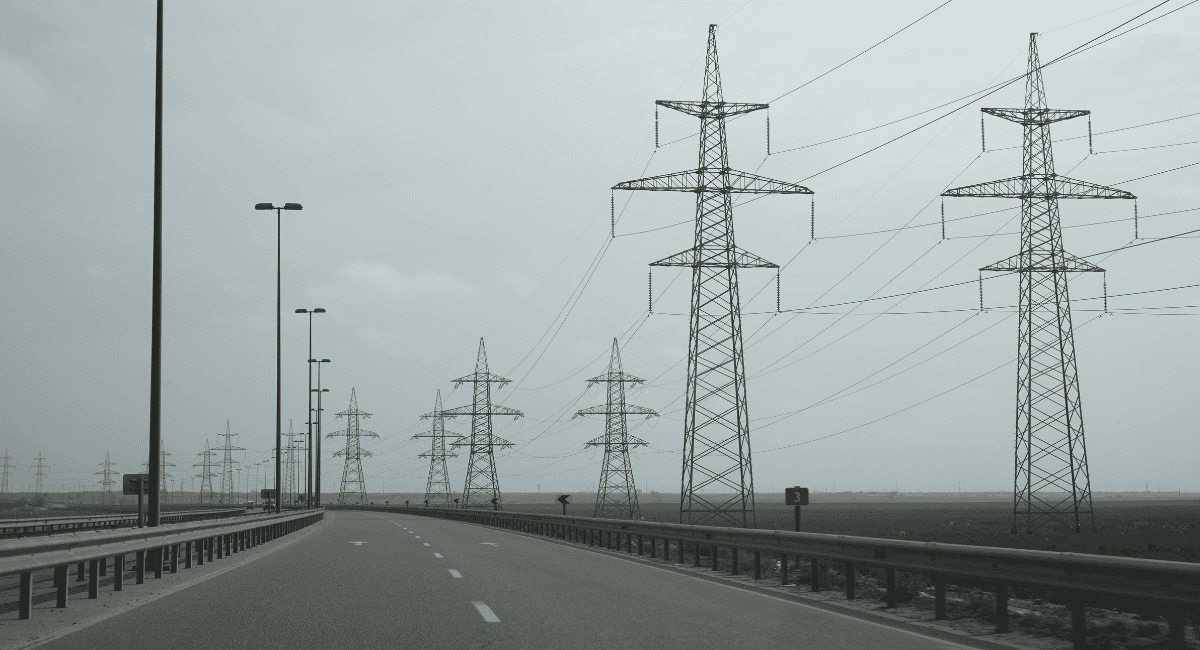
Nigeria’s electricity distribution companies have mastered the art of extracting trillions of naira from a country kept in perpetual darkness. If surging revenue alone could power tech hubs, server racks and factory floors, Africa’s most populous nation would be witnessing an industrial renaissance. Instead, the NERC 2026 Q2 financial filings expose a broken market where aggressive tariff hikes mask the physical decay of the national grid.
Between the first six months of 2018 and the first half of 2026, revenue collected by Nigeria’s 11 Distribution Companies (DisCos) surged by 450%, climbing from ₦218.16 billion to ₦1.2 trillion. Yet over that exact eight-year window, actual electricity supplied to consumers crept up by a negligible 4.8%, moving from 16,861 gigawatt-hours (GWh) to 17,668 GWh, according to data from the Nigerian Electricity Regulatory Commission (NERC). Worse still, average available generation capacity plummeted by 41% during the same period, dropping from 7,565.5 megawatts (MW) in early 2018 to 4,456 MW in the first half of 2026.
Nigerians are not buying more electricity; they are simply paying drastically more for the same rationed megawatts.
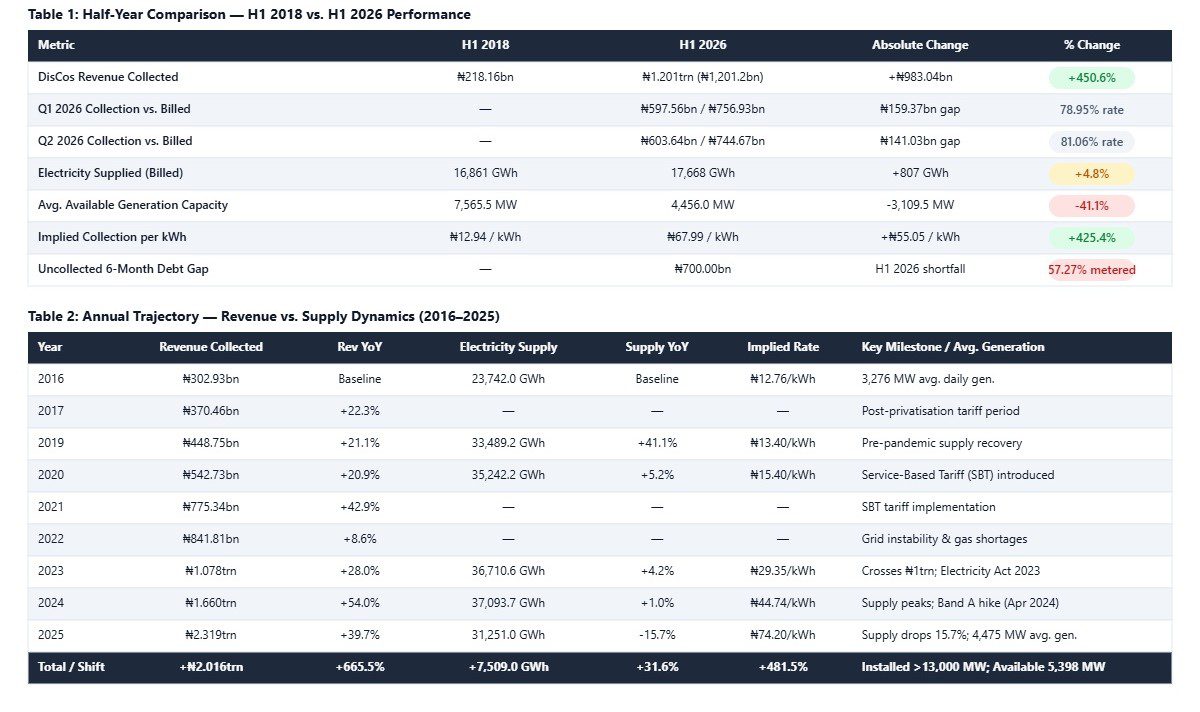
The disconnect between revenue collection and energy delivery grew sharpest between 2024 and 2026. Following the introduction of the Service-Based Tariff adjustments and the steep Band A rate increases in 2024, annual DisCo revenues jumped from ₦1.66 trillion in 2024 to ₦2.32 trillion in 2025. Across that same twelve-month stretch, total annual electricity supply actually contracted by 15.7%, falling from a peak of 37,093.70 GWh in 2024 to 31,251 GWh in 2025.
Even with collections hitting record nominal highs in 2026, the sector’s commercial plumbing remains porous. DisCos recorded a ₦700 billion shortfall between energy billed and revenue collected in the first six months of 2026 alone. Meanwhile, NERC’s fourth-quarter 2025 disclosures show that while national metering reached 57.27% (6.97 million metered accounts out of 12.16 million active customers), more than 5.19 million active consumers remain trapped on estimated billing, forcing the regulator to issue monthly energy caps in May 2026 to curb arbitrary overcharging.
The broken promises of the 2010 Power Roadmap
To understand how Nigeria arrived at this cul-de-sac, one must revisit August 2010, when the federal government unveiled the Roadmap for Power Sector Reform. Building on the Electric Power Sector Reform Act of 2005, the blueprint promised to end chronic blackouts by unbundling the state-owned Power Holding Company of Nigeria (PHCN) into 18 successor entities: six generation companies (GenCos), 11 DisCos, and the state-retained Transmission Company of Nigeria (TCN). The Roadmap projected attracting $3.5 billion annually in private investment to push generation capacity toward 40,000 MW by 2020.
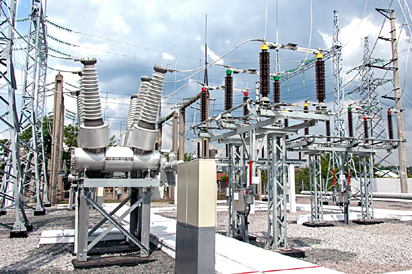
When core investors took over the privatised assets in November 2013, the sales were hailed as a watershed moment. In practice, the transaction transferred public monopolies to heavily leveraged consortiums that lacked both the technical expertise and the equity capital to upgrade decaying substations. Because the now-new owners borrowed heavily from local banks to fund the acquisitions, their balance sheets buckled the moment the naira weakened and gas shortages hit.
Thirteen years after privatisation, Nigeria has over 13,000 MW of installed capacity on paper, yet average daily generation is about 4,475 MW, a far cry from the 40,000 MW generation capacity projected for 2020 when the Power Roadmap was launched some 16 years ago.
Every link in the value chain blames the next. DisCos reject power or fail to remit funds in full; GenCos starve for gas because vandalism and dollar-denominated pricing disputes cripple pipelines; and TCN’s fragile grid repeatedly trips, recording over 100 collapses in the last ten years.
Rather than weaning the treasury off subsidies, the privatised market has accumulated up to ₦6 trillion in legacy sector debts, compelling President Bola Tinubu’s administration in 2026 to approve a ₦3.3 trillion settlement plan backed by hundreds of billions of naira in cash and non-cash bonds. While the Electricity Act 2023 has allowed 15 states to assume regulatory control of their intrastate markets as of 2026, decentralisation has yet to translate into new electrons on the wire.
The energy tax choking Nigeria’s tech industry
Across the broader economy, where the Rural Electrification Agency estimates that 85 million citizens still lack grid access, this dysfunction acts as a punitive tax on productivity. Manufacturing firms and small businesses burn trillions of naira annually on diesel and petrol generators just to stay open. Nowhere is this challenge more destructive to Nigeria’s future than in its technology ecosystem.
Modern digital infrastructure runs on uninterrupted, high-density electricity. In May 2026, a landmark survey by the Innovation Support Network (ISN) warned that Nigeria’s digital and startup hubs face an existential survival crisis, with over 60% of hubs citing erratic power and punishing utility costs as their primary operational threat. Early-stage startups that should be deploying venture capital into software engineering and product growth are instead diverting runway into Band A electricity bills, diesel supply contracts, and solar-inverter arrays.

At the infrastructure layer, the penalty is even steeper. According to a January 2026 market analysis by Mordor Intelligence, captive power and redundancy systems, including dual generator banks, uninterruptible power supplies, harmonic filters, and voltage-conditioning transformers, swallow between 30 and 40% of total data centre construction budgets in Nigeria. Grid unreliability and diesel volatility shave nearly five percentage points off the projected compound annual growth rate of Nigeria’s data centre power market, which reached $120.38 million in 2026.
The International Monetary Fund estimates that artificial intelligence could boost sub-Saharan Africa’s economic output by 4% over the next decade, but explicitly warns that power shortages threaten to erase those gains. Nigeria cannot build a globally competitive twenty-first-century cloud and AI economy on a 4,456-megawatt grid, no matter how many trillions its DisCos make.
