

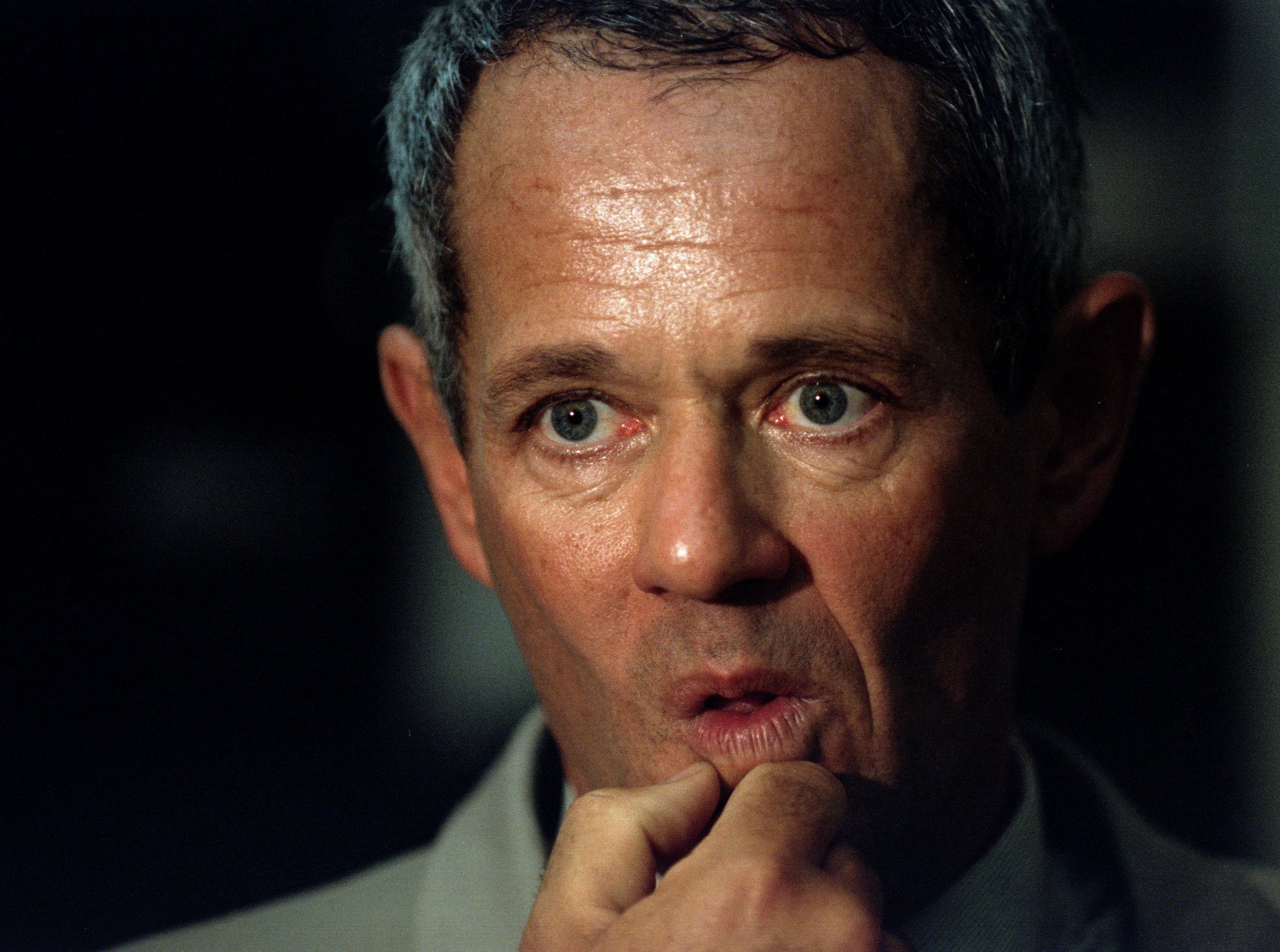
Some placed him among the Affreux, the European mercenaries, mainly French, Belgian and Italian, who operated across Africa from the early 1960s as countries gained independence. But Paul Barril belonged more to the generation that followed.
He maintained close ties with Bob Denard, the notorious French mercenary associated with the era of Jacques Foccart, the architect of France’s postcolonial networks in Africa. Barril died in France on 20 October, aged 80.
From deputy of elite force to political liability
He rose to prominence under François Mitterrand, at a time when socialism and Françafrique, France’s shadowy network of political and business interests on the continent, coexisted comfortably at the Élysée Palace.
Barril joined the Groupement d’Intervention de la Gendarmerie Nationale (GIGN), France’s elite gendarmerie tactical unit, when it was established in 1974. A trained combat diver and deputy to its commander, Christian Prouteau, he served as acting head from 1982 to 1983 while Prouteau oversaw security for the French presidency.
Following in his superior’s footsteps, Barril was later frequently described as the second-in-command of the Élysée’s anti-terrorism unit. By then, the captain had become one of the most recognisable faces of France’s elite gendarmerie during Mitterrand’s first seven-year presidential term.
But Barril was already embroiled in controversy. His involvement in the 1982 Vincennes Irish affair, followed by the Élysée wiretapping scandal, which saw more than 100 public figures placed under surveillance between 1983 and 1986, made him a political liability. Mitterrand publicly distanced himself from Barril, reportedly calling him a “thug” and ordering the withdrawal of his access pass to the presidential palace.
But Barril had already seen the writing on the wall. In 1984, he moved into the private sector, founding Epsylon and later Secrets, a security consultancy. He then turned his attention to Africa.
In the Habyarimana couple’s inner circle
Was it money or adventure that drew the gendarme, who officially remained in the force until 1995 and occasionally wrote novels, to Africa? As early as 1984, Barril accompanied Mitterrand to Burundi for the France-Africa summit, where his duties included inspecting vehicles assigned to the French president and his entourage. As he gradually moved into private business, he began working with François de Grossouvre, one of Mitterrand’s influential behind-the-scenes advisers on African affairs.
With the backing of one of the best-connected figures in the French establishment, Barril thrived in the shadows of power. In the early 1990s, he established himself in Cameroon, officially to train soldiers in riot control and ensure the presidential guard was properly equipped and prepared. But his activities went further.
From the Mont-Fébé Hotel, he met with President Paul Biya’s intelligence chiefs and advised them on political surveillance as Cameroon embraced multiparty politics and faced a growing anglophone opposition viewed with suspicion at the Élysée.
But Rwanda became the centre of Barril’s business activities in Africa. The earliest evidence of his involvement dates back to 1989, when his company invoiced a colonel in the Rwandan Armed Forces for security screening gates, metal detectors, Beretta submachine guns and quick-opening suitcases. From then on, he maintained close ties with the inner circle of then-president Juvénal Habyarimana, one of Mitterrand’s key African allies. Those ties continued until 1994, as the regime prepared for the genocide against the Tutsi.
On 6 April 1994, Habyarimana was killed when his plane was shot down. On 28 May, as the killings had been underway for nearly two months and 11 days after the UN arms embargo on Rwanda came into force, Barril signed a controversial assistance contract with Jean Kambanda, prime minister of the interim government. The agreement, worth $3.13m, covered specialist personnel and weapons, with a 50% advance payment. A month earlier, in a letter dated 27 April and signed by Rwanda’s defence minister, the Frenchman’s agreement to recruit 1,000 men had also been mentioned.
The man who championed the theory of the RPF’s guilt
Barril insisted that the contracts had never been implemented. He also claimed that de Grossouvre and Mitterrand had instructed him to infiltrate Rwanda’s armed opposition. Among other encounters, he said he met President Paul Kagame, then a leader of the Rwandan Patriotic Front (RPF), in Brussels in 1992.
Barril alleged that Kagame had built a domestic terrorist network in Rwanda that would later become “the driving force behind the genocide” of the Tutsi in 1994. His claims remain unsubstantiated and contradict established findings on the genocide.
Did Barril attempt to influence French judicial investigations to divert them from the truth?
Barril would defend this theory of the RPF’s culpability for years. Following the 6 April 1994 attack, Habyarimana’s widow, Agathe, gave him a mandate to investigate on 5 May. Four days later, Barril travelled to Rwanda with four men, remaining there until 23 May. On 28 June, he told French television channel Antenne 2 that he had proof of the RPF’s guilt. The evidence he cited included the aircraft’s “black box”, recordings from the control tower and missile tubes recovered near the crash site.
The theory was subsequently adopted and promoted in France in the early 2000s by investigating magistrate Jean-Louis Bruguière, before being discredited. Years later, technical assessments commissioned by judges Marc Trévidic and Nathalie Poux established that the missiles which brought down the presidential aircraft on 6 April 1994 had been fired from a position controlled by Habyarimana’s presidential guard.
Did Barril attempt to influence French judicial investigations to divert them from the truth – namely, that the genocide had been triggered by extremists associated with “Hutu Power”? And, if so, on whose behalf?
For some, he was the Élysée’s enforcer in the African Great Lakes region, an allegation that Mitterrand and his entourage denied, seeking to rebut accusations that France had been complicit in the genocide of the Tutsi. Others believed that the adventurer had eventually become a liability to French intelligence services. He was too volatile and indiscreet, they would say, as a way of washing their hands of him.
A puzzling decision to drop the case
In 2013, the French Human Rights League (FIDH) and the Survie association filed a complaint in Paris against the former gendarme, accusing him of “complicity in genocide”. One of the principal aims, FIDH president Patrick Baudouin said at the time, was to examine the relationship between Barril, the Élysée and French intelligence services.
“One cannot avoid questioning the links between Barril and the French authorities, and the tolerance that he enjoyed at their hands,” the lawyer said.
Although a judicial investigation was opened relatively quickly, Barril was not questioned by an investigating judge until May 2020, seven years after proceedings began. His health had deteriorated severely as a result of Parkinson’s disease and cancer. He was not formally charged and instead held the status of témoin assisté, a form of assisted witness status under French law.
Insufficient evidence to proceed against any of the nine people under investigation
The latest development in the case has favoured him. On 26 May this year, France’s national anti-terrorism prosecutor’s office called for a surprising decision to drop the case against him.
As in the case of Agathe Habyarimana, who has also faced allegations of complicity in genocide, prosecutors argued in their submissions to the investigating judge that there was insufficient evidence to proceed against any of the nine people under investigation.
They nevertheless acknowledged several facts, including Barril’s ties to Habyarimana’s inner circle, his commission to investigate the attack on the presidential plane, his training of Rwandan military personnel and a military assistance contract signed on 28 May 1994.
The prosecutor’s office concluded that these elements were useful in understanding the context but insufficient to establish complicity in genocide.
Agathe still faces the possibility of trial over a separate complaint filed in France in 2007. In August 2025, she secured a decision to drop the case against her, but the Paris court of appeal overturned it on 6 May 2026. Her lawyers subsequently appealed to the Cour de Cassation, France’s highest court for civil and criminal cases.
The legal battle in France continues, but without the controversial Barril.
