

Africa’s maritime coastline features 179 ports, according to a continental transport database published in Scientific Data in December 2025. Yet physical access to water does not equate to affordable freight. Before a shipping container reaches an enterprise warehouse, it must clear quay cranes, navigate customs bureaucracy, and connect with inland road or rail corridors. A structural delay at any single node converts a routine delivery into an expensive commercial ordeal.
At several African terminals, a haulage truck dispatched to pick up an import container can spend up to seven days idling outside the gate, according to Toby Maier, CEO for the Middle East and Africa at DHL Global Forwarding. While the vehicle sits stranded in access queues, driver wages continue to accrue, fleet utilisation collapses, and compounding port storage fees are slapped onto the bill.
“Somebody has to pay for the truck, the driver, and the waiting time,” Maier told TechCabal. For Maier, Africa’s punishing logistics costs are rarely driven by a physical deficit of berths; they stem from friction in the operational tissue linking ships, quaysides, customs authorities, and domestic distributors.
A port is only one link in the chain
While the African Transport Systems Database catalogued 179 ports or maritime harbours alongside 132 inland river ports and dry docks, that inventory registers physical facilities rather than throughput efficiency, container dwell times, or handling capacity. To a manufacturing firm or importer, a terminal’s commercial value is defined by dwell velocity and clearance predictability, not its presence on a maritime chart.
Maier contrasts the multi-day gridlock outside regional African gates with state-of-the-art facilities in Abu Dhabi, where gate-in to gate-out container collection takes roughly 15 minutes. This contrast juxtaposes greenfield Gulf capital against older African legacy infrastructure. Still, it also captures a structural commercial reality: freight invoices penalise shippers for wasted time as much as for nautical miles travelled.
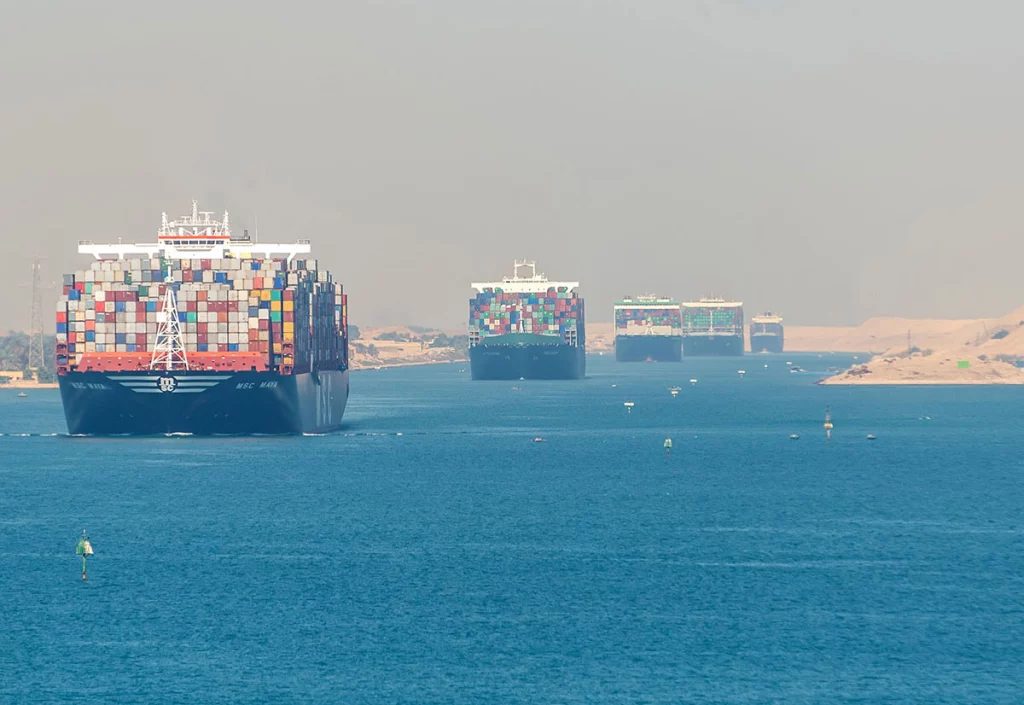
Ships carrying cargo through the Suez Canal were delayed or forced to reroute as the war in the Middle East disrupted maritime traffic. Image source: Worldwide Logistics Group
“For me, it’s always very ironic that, in a continent where available GDP per capita is the lowest in the world, people have the highest logistics cost per unit because of the inefficiencies in the overall system,” he said.
Maier supplied no comparative dataset substantiating that global ranking. His account nevertheless identifies several sources of expense: inadequate infrastructure, inconsistent clearance procedures, documentation problems and limited transport capacity.
Technology can improve parts of the journey. Morocco’s APM Terminals MedPort Tangier, which began operations in June 2019, uses remote-controlled ship-to-shore cranes, 70 automated rail-mounted gantry cranes and automated gate lanes. The operator describes a combination of conventional and advanced-technology operations.
Such equipment can improve cargo handling, but automating a terminal does not automatically resolve problems elsewhere in the supply chain. Goods still need regulatory approval and reliable onward transport.
For Africa’s 16 landlocked developing nations, these domestic delays compound exponentially at sovereign borders.
In an August 2025 assessment, UN Trade and Development (UNCTAD) reported that landlocked developing nations globally confront freight costs 50% above world averages and endure transit times twice as long as coastal neighbours.
Upgrading a coastal terminal in Mombasa, Tema, or Durban solves only one link of that transit: inland enterprises remain hostage to fractured roads, informal checkpoints, and misaligned customs protocols.
Corridor modernisation, however, proves these bottlenecks are solvable. Along East Africa’s Northern Corridor, targeted customs digitisation and integrated border management at Malaba—the crossing point between Kenya and Uganda—slashed transit delays from three days to three hours, demonstrating how inter-governmental coordination can eliminate trade friction without multi-billion-dollar dredging projects.
Customs turns waiting into a bill

A customs officer inspects luggage at OR Tambo International Airport in Johannesburg, South Africa. Image source: World Customs Organisation
Customs clearance remains the single most volatile point of friction, where physical assets freeze while financial liabilities multiply.
“Customs clearance continues to complicate shippers’ operations and inflate outlays,” Maier observed. “The moment a container is delayed, statutory demurrage and private quay storage charges compound rapidly, creating severe financial distress.”
The expense rarely comes from statutory tariffs alone; it is driven by arbitrary manual inspections, opaque valuation assessments, and incompatible electronic document standards. Yet Maier acknowledges that private shippers often engineer their own distress by filing flawed paperwork, mismatched HS codes, or incorrect declaration templates.
To mitigate this, DHL enforces an administrative pre-clearance protocol. For sensitive imports—such as volatile chemicals, regulated pharmaceuticals, and hazardous cargo—the forwarder applies a “green-light” gate: containers are barred from departing their port of origin until all destination documentation and clearance permits have been audited and logged.
Catching administrative discrepancies after a vessel has berthed is catastrophic: cargo locked in demurrage disputes can generate penalties exceeding the intrinsic value of the freight itself.
However, calculating customs’ exact proportion of African transport invoices remains impossible to aggregate.
“It varies country by country, transport mode by transport mode, and client by client,” Maier said, declining to supply specific corridor cost breakdowns.
Broader development benchmarks show the dramatic fiscal upside of administrative reform. UNCTAD reports that its Automated System for Customs Data (ASYCUDA)—deployed across two-thirds of the world’s landlocked developing economies—has compressed clearance intervals by up to 90% in modernised ports.
Recognising that human error triggers a significant share of port hold-ups, forwarders are investing in compliance education.
Through its GoTrade initiative, DHL has trained more than 28,000 small and medium-sized enterprises (SMEs) globally—including 11,000 across sub-Saharan Africa—on export documentation, international trade finance, and customs classification.
Yet educational outreach has clear limits: training local exporters to file flawless paperwork cannot compensate for unpaved trunk roads, corrupt border posts, or down customs servers.
More capacity is not always cheaper capacity
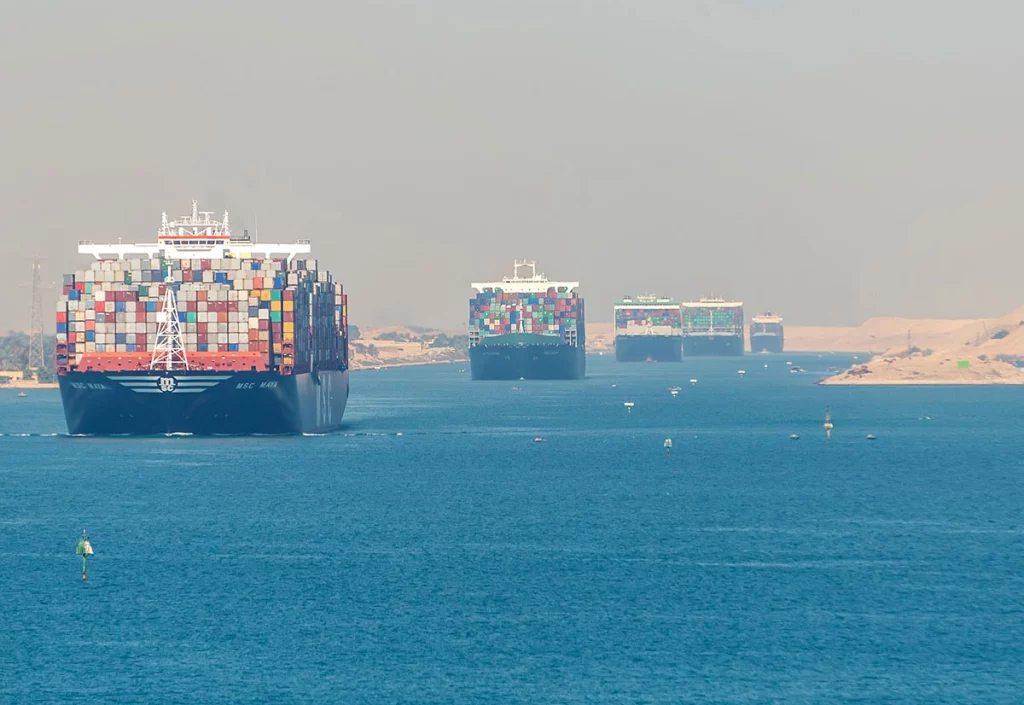
Ships carrying cargo through the Suez Canal were delayed or forced to reroute as the war in the Middle East disrupted maritime traffic. Image source: Worldwide Logistics Group
Even an efficient port cannot insulate businesses from global freight-market disruption.
Maier estimates that fuel accounts for roughly one-third of transportation costs, depending on the mode. He said jet fuel prices had more than doubled during Middle East disruption, although he supplied no reference period or price series.
African businesses also compete with other markets for aircraft and vessel space. When carriers can earn more elsewhere, capacity can shift away, making available services more expensive.
Some companies previously distributing spare parts through Dubai were serving Africa directly from China or Europe instead, Maier said.
DHL Global Forwarding’s role is to assemble alternatives across airlines, shipping lines and road connections.
“We are a bit like a travel agency for cargo,” he said.
He described solar-related exports from East Africa to North America facing tariff deadlines and insufficient direct capacity. DHL routed cargo through Johannesburg to access additional space, although he did not identify the customer or quantify savings.
The company also uses data and AI to assess routing and combine cargo of different weights and volumes to use aircraft capacity efficiently. Sometimes, Maier said, a different airport and two additional days can produce a cheaper journey.
These services compete in a substantial market. Ken Research estimates Africa’s freight-forwarding market at $18.2 billion in 2025, rising to $27.73 billion by 2032. Its commercial estimate covers forwarding services, including routing, customs brokerage and consolidation—not the entire logistics industry.
DHL is pursuing that opportunity through a planned investment exceeding €300 million in sub-Saharan Africa, announced in October 2025. The multi-year commitment spans Express, Global Forwarding and Supply Chain, rather than Global Forwarding alone.
Maier identified healthcare, renewable energy, perishables and data-centre equipment as priorities. But he declined to provide Africa-specific revenue or service-performance figures demonstrating progress.
That leaves an important distinction between investment and outcomes. More facilities, equipment and shipping options may expand capacity; they do not automatically produce lower customer bills.
Africa’s 179 ports provide entry and exit points for trade. Making that trade affordable depends on what happens between the ship and the customer: predictable clearance, functioning inland connections, and less time spent paying for cargo that is going nowhere.
True scale demands moving beyond surface-level integrations to robust execution. We’ve filtered the noise out of Moonshot 2026, optimising the conference strictly for high-calibre connections between startup founders, global financial operators, enterprise leaders and individuals rewiring Africa’s technical frameworks. Get 20% off Early Bird tickets for a limited time.

