

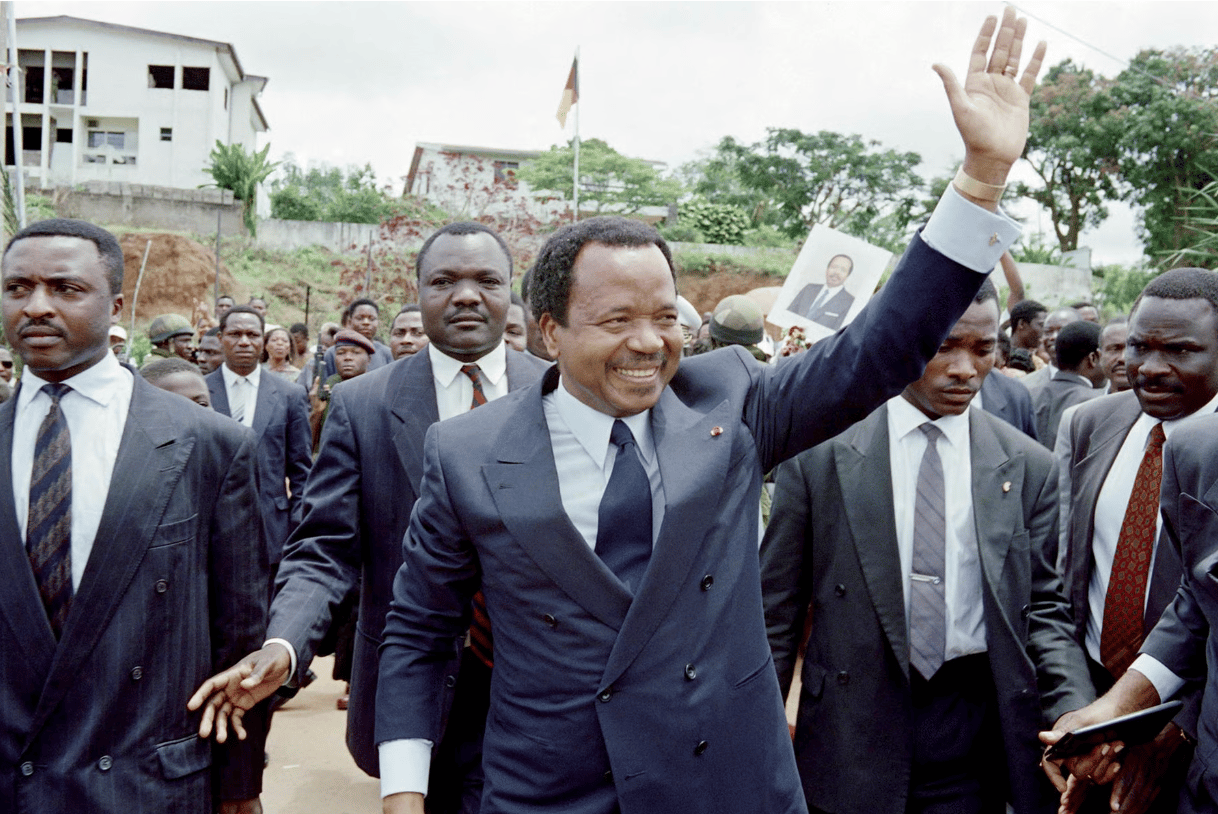
In early 1991, the winds of democracy were blowing through Cameroon. Paul Biya had agreed to legalise multiparty politics in December 1990, hoping to calm the protests sparked by the arrest and trial of the lawyer and opposition figure Yondo Black. The Cameroonian president was also responding to François Mitterrand’s speech at La Baule, in which the French president said French aid to Africa would take greater account of democratic progress on the continent.
But while Biya knew the mood was turning against the one-party system he had dominated, he had no intention of being swept into a democratic adventure he could not control. Other African presidents had thrown themselves into the turmoil of national conferences; Biya refused. Such a gathering was pointless in Cameroon, he said, since multiparty politics was already in place and steps had been taken to protect civil liberties.
A conference, yes – but not a sovereign one
Part of the opposition was not convinced. Figures such as Samuel Eboua, John Fru Ndi, Mboua Massock and Jean-Jacques Ekindi continued to demand a conference to “take stock of what has happened and how the country has been run until now, and to set a course for the future”. After the presidency in Etoudi rejected its demands, the opposition called for “ghost town” days on 18 and 19 April 1991, followed by peaceful marches.
The protests grew. On 27 June 1991, the president publicly rejected a sovereign national conference, and the crisis became a trial of strength. For months, demonstrations, riots, general strikes and mass arrests shook the main cities. The country was in flames, and there was talk of hundreds of deaths. Biya declared a de facto state of emergency and set up “operational military commands” to restore order.
In Douala on 20 September, the president condemned the ghost town operations and called for reconciliation, seeking a way out that did not mean conceding a sovereign conference. The answer was a narrower dialogue, centred on Sadou Hayatou, appointed prime minister five months earlier. The tripartite talks opened at the Palais des Congrès in Yaoundé on 30 October 1991, with about 300 delegates from the government, the opposition and civil society.
Talks that split the opposition
Hayatou led the government delegation and chaired the proceedings. Biya, true to form, stayed in the background, which spared him from being personally tied to any compromise. Opposition figures including Ndi, Eboua, Adamou Ndam Njoya and Hamadou Moustapha took part, as did Cardinal Christian Tumi, a leading figure in the Catholic church.
Three of the parties in the National Coordination Committee of Opposition Parties (NCCOP) did not participate in the talks, but most opposition figures engaged in Biya’s initiative. The opening speeches amounted to an indictment of the regime, with most of the participants taking stock of Cameroon’s political crisis, condemning the violence and debating the country’s political future. But there was little real dialogue. On 4 November, the NCCOP suspended its participation, accusing Hayatou of ignoring its demands.
Eboua, then president of the Union nationale pour la démocratie et le progrès (UNDP), took a delegation to the diplomatic missions to set out the opposition’s case, while Njoya of the Union démocratique du Cameroun (UDC) led another to negotiate with Hayatou, notably on constitutional reform. Two camps emerged, though not irreconcilable ones: both still wanted a political overhaul.
The final declaration, signed on 13 November 1991, promised measures to ease tensions, changes to the electoral code and constitutional revision — without handing power to a transitional body or touching Biya’s institutional position. Nor did it bind the government to honour its commitments as the opposition wanted. Biya had kept control.
A springboard to the 1992 presidential election
The constitutional revision went to a technical committee. In December 1991, parliament passed a new electoral law without further consultation with the opposition, which condemned bans on independent candidates and party alliances, unfair constituency boundaries and the alleged bias of electoral commissions answerable to an administration controlled by the ruling Cameroon People’s Democratic Movement (CPDM).
Ndi’s Social Democratic Front (SDF) and several other parties boycotted the legislative elections of 1 March 1992. Others, including the UNDP, now led by Bello Bouba Maïgari, took part. “It’s a first election, it won’t be perfect,” a French embassy official said in Yaoundé at the time. The CPDM won 88 of the 180 seats while the UNDP took 68. Biya was denied the absolute majority he wanted, but the opposition was fractured.
Biya knew this and set the presidential election for 11 October, in a single round. This time Ndi ran, at the head of an opposition coalition, against both Biya and Magari. The SDF leader claimed victory with 38.67% of the vote against 36.86% for the incumbent, but Biya was declared the winner with 39.98% to 35.97%. Bello Bouba was credited with 19.22%, and the UNDP then joined the government.
“Paul Biya held on to power in 1992 by playing on the opposition’s divisions. And if he was able to do that, it was because he kept control of the 1991 tripartite talks. That would not have happened with a sovereign national conference,” says a Cameroonian political scientist.
Thirty-five years on, the system Biya built remains locked down and rests on the same foundations. Despite multiparty politics, Cameroonians are still waiting for their first change of power through the ballot box.
