

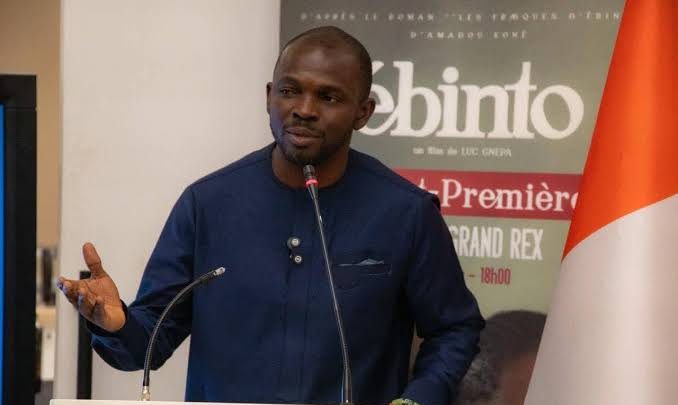
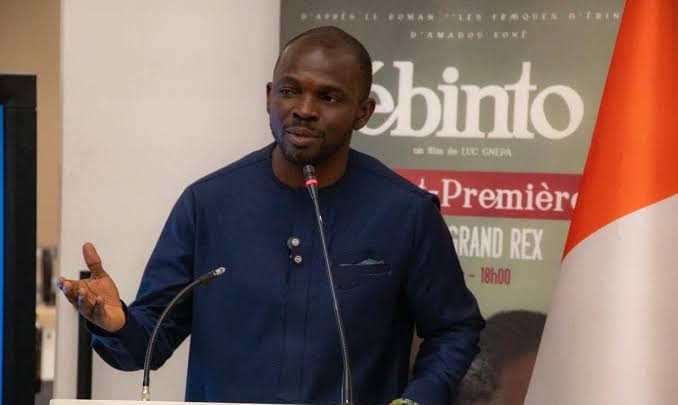
I bumped into Charly Kodjo at the just-ended CANEX WKND 2026 in Lagos, Nigeria. We had barely exchanged pleasantries when the young Ivorian film producer offered to sit over a drink and talk about the future of African cinema. It was an invitation I could hardly refuse.
We settled into the lobby of the Main Bowl at the Wole Soyinka Centre for Culture and the Creative Arts. What started as a casual chat about filmmaking soon turned to bigger questions about who tells Africa’s stories, who pays to bring them to the screen and, above all, who owns them.
“I firmly believe that to take control of our narrative, we absolutely must fund our own stories; it’s a matter of cultural survival and for us, that’s non-negotiable,” Kodjo tells me.
Only days earlier, his latest film Ébinto had attracted more than 2,500 people to a premiere at the Grand Rex, one of Paris’ most celebrated cinemas. But his ultimate ambition is not another glittering European premiere. He dreams of African films being watched and discussed in villages across the continent, in languages their audiences understand.
It is an intriguing contrast for a producer finding success internationally while questioning why Africa still struggles to build an industry capable of serving its own people.
Fighting the negative image of Africa
From 5 to 8 November, the Lagos cultural complex had become a gathering point for Africa’s creative heavyweights and emerging talents. Organised by the African Export-Import Bank (Afreximbank), CANEX WKND brought together filmmakers, musicians, fashion designers, investors and policymakers from across Africa and its diaspora to explore how creativity could become serious business.
Kodjo, as I would discover, has more than a few ideas about making that happen. His credentials are impressive. He founded Instant2Vie Studio in 2014, beginning with photography before expanding into documentaries, television and feature films. He also trained at La Fémis, France’s prestigious film school in Paris.
[In Europe] the image of Africa I see is portrayed in a pessimistic light
His television series Ici c’est Babi, co-produced with TV5Monde and directed by Boris Oué, received a special jury mention in the television series category at FESPACO in Burkina Faso in 2023. It subsequently won the Laurier Francophone du Sud at France’s Lauriers de l’Audiovisuel awards in 2024.
That year, Instant2Vie secured a €130,000 (about $144,000) DEENTAL audiovisual production award from France’s National Centre for Cinema and the Moving Image (CNC). In 2026, the company won the CPACI award for best production company at Côte d’Ivoire’s NISA awards.
But accolades alone are not what drive Kodjo.
“When I walk through the streets of certain European capital cities, the image of Africa I see is portrayed in a pessimistic light,” he says. He describes charity appeals featuring vulnerable African children and international media coverage that too often associates the continent with poverty, conflict and irregular migration.
Africa certainly has problems, he acknowledges. But these should not define a continent brimming with ambitious young people and opportunities.
For Kodjo, filmmaking offers a chance to challenge that imbalance without pretending Africa is perfect. The objective is not to manufacture positive stories, but to ensure Africans have the resources and freedom to tell their own.
A Paris breakthrough, financed at home
Ébinto is perhaps the clearest expression of that philosophy. Adapted from Amadou Koné’s celebrated 1975 novel Les Frasques d’Ébinto, the feature film was directed by Luc Gnépa and produced in Côte d’Ivoire, drawing largely on domestic financing. Getting investors to believe in the project, however, demanded patience.
“It took us five years to convince local donors – private and public – as well as government agencies to believe in our model and today that is beginning to bear fruit,” Kodjo recalls.
Every country moves at its own pace
His team committed its own money before attracting private investors, government support and backing from businesses, including Ivorian broadcaster La Nouvelle Chaîne Ivoirienne. The approach was deliberate. Rather than depending entirely on foreign financiers, Kodjo wanted to demonstrate that African institutions and businesses could support ambitious local productions.
Then came Paris. On 29 October, Ébinto attracted 2,509 admissions to its international premiere at the Grand Rex. Four additional screenings were also reported sold out, with a wider French theatrical release planned for December. For a film adapted from an Ivorian literary classic, it was a significant international breakthrough.
Yet a packed Paris cinema does not necessarily translate into a profitable film. And Kodjo knows that one successful production is not enough to build an industry.
I ask him about Nollywood, the Nigerian filmmaking powerhouse whose output and global influence have become a benchmark for the rest of Africa. “I don’t want to make comparisons, but I think every country moves at its own pace,” he responds.
Côte d’Ivoire, he explains, is developing its own approach, drawing lessons from Nigeria while trying to avoid replicating its model wholesale. What interests me most is his argument that the industry’s biggest obstacle is not necessarily money, even though raising financing for Ébinto took five years. Kodjo believes the deeper problem lies in the fragmented value chain connecting production, distribution, marketing and exhibition.
His solution is what he calls a “360-degree model”. Through Ébinto, his team has developed distribution and marketing operations, including dubbing capabilities. He says they have also opened an outdoor cinema in Grand-Bassam, the historic Ivorian coastal city recognised as a UNESCO World Heritage Site.
The hope is to create infrastructure that other filmmakers can use, rather than starting from scratch with every production. “It’s a model we’re testing and we hope it will work,” he admits.
A landmark UNESCO study published in 2021 estimated that Africa’s film and audiovisual industries generated about $5bn annually and supported five million jobs. With stronger investment and infrastructure, it suggested the sector had the potential to generate $20bn and create more than 20 million jobs.
Kodjo’s challenge is turning that potential into a sustainable business, one film and one audience at a time.
Who owns Africa’s stories?
But who profits when African films become international hits? Foreign investment and distribution deals have opened global doors for African filmmakers, while raising questions about ownership, revenue sharing and creative control.
Kodjo warns that Africa must address these concerns before its film industry becomes overly dependent on foreign players. “There is still time to create a regulatory framework that allows African producers to retain full ownership rights to our stories,” he says.
Nurturing talent is as important as making films
He is not opposed to international partnerships, but wants African producers to negotiate from a position of strength. Afreximbank’s Africa Film Fund, backed by a commitment of up to $1bn for production, distribution and infrastructure, offers an opportunity. But Kodjo argues that financing must reflect local realities.
“A South African producer should not be treated the same way as a producer from Côte d’Ivoire or Guinea,” he says, pointing to differences in infrastructure, production capacity and market maturity.
Language is another obstacle. Despite their proximity and shared cultures, anglophone and francophone African film industries often operate in separate markets.
Kodjo hopes dubbing can bridge that divide. His film Ébinto is being dubbed into English and Portuguese, with plans for African-language versions, including Yoruba, Baoulé, Swahili and Bambara. But reaching wider audiences also means building cinemas beyond major cities and training the next generation of filmmakers.
Together with fellow producer Cynthia Nassadine, Kodjo founded Creative Lab, which trains young people in film and audiovisual production. Among its graduates is Senegalese Penda Ndiaye, who worked as a clapperboard operator on Ébinto. For Kodjo, nurturing talent is as important as making films.
As our conversation draws to a close, I ask what success would look like if we met again for coffee in 10 years. His answer is not another award, a bigger budget or a Hollywood breakthrough. “My greatest achievement in 10 years: I see young people in a Yoruba village discussing an African film dubbed into Yoruba,” he says.
