

In partnership with Equipment Hub
In 2012, while setting up an equipment dealership in Ghana, Mark Bacon watched the world’s biggest equipment players treat Africa as an afterthought. Fourteen years, several businesses and one name change later, his company Equipment Hub has built what he says the market always needed: a single place where construction, mining, agricultural and transport machinery meets finance, logistics and inspection.
Ask Mark Bacon when the idea for Equipment Hub was born and he does not hesitate. “2012,” he says. “I was setting up a dealership in Ghana, and I could see the demand everywhere. Roads, mines, ports, housing. What I couldn’t see was anyone seriously putting the pieces together.”
The British entrepreneur, founder and CEO of UK-registered Equipment Hub Ltd, has now spent more than 15 years building and running equipment businesses across the continent. His argument has stayed remarkably consistent: Africa never had an equipment problem. It had a connection problem.
In 2012 Ghana, like much of the continent, was in the middle of an infrastructure push. Contractors needed excavators, loaders and haul trucks. Mines and project owners were sitting on fleets they no longer used. Yet the major manufacturers, dealer groups and financiers largely kept Africa at arm’s length: thin dealer coverage, little appetite for local credit risk, and service networks that stopped at the capital cities.
The result was a fractured market. A contractor in one country might wait months for new kit, or buy used machines unseen from abroad with no inspection, no warranty and no clear route through shipping and customs. Meanwhile, perfectly good equipment sat idle a border away because its owner had no way to reach a buyer.
“Everyone was doing one piece,” Bacon recalls. “A dealer here, a freight forwarder there, a bank that might or might not lend against the asset. The buyer was the one left stitching it all together, and usually paying for it.”
Why do you think the big players held back from Africa?
“Risk perception, mostly. Head offices looked at a map and saw 54 markets, each with its own currency, regulations and logistics. It was easier to serve a couple of hubs and leave the rest to whoever turned up. Not because the demand wasn’t there. It was. But the model they ran in Europe or North America didn’t translate, and few were willing to build a new one.”
You spent years inside that system. What did it teach you?
“I’ve been at the sharp end: dealerships, aftersales, asset disposal, senior commercial roles across several African countries. You learn quickly that selling the machine is the easy part. Getting it financed, inspected, shipped, cleared, insured and supported afterwards is where deals live or die. That’s where the value sits, and that’s exactly where the market was weakest.”
What does “connecting the dots” mean in practice?
“It means the buyer shouldn’t need ten relationships to buy one excavator. They should find the machine, see who can inspect it, who can ship it, who can finance it and who can insure it, all in one place. And on the seller’s side, a mine or contractor with a surplus fleet should have a clear, credible route to turn idle steel back into capital.”
Where does export finance fit in?
“It’s one of the most underused tools for African projects. Export credit agencies can back serious projects, but you need the right equipment, the right documentation and the right structure. We help contractors source equipment that fits those frameworks, meet UK-content requirements and get the paperwork ready. For many buyers that’s the difference between a project happening or not.”
What would you say to the manufacturers and dealers who still see Africa as too hard?
“Come in through a partner who already knows the ground. You don’t have to build everything yourself. List your equipment, plug into the service network, and let the platform handle the parts that used to scare people off.”
“Africa never lacked machines or demand. It lacked someone joining the dots.”
Bacon founded the business in 2017 as Equipment Africa Ltd, initially focused on equipment and asset disposal. In December 2023 it became Equipment Hub Ltd, reflecting a broader ambition: to be a full-service partner for African projects rather than a broker of individual machines.
Today the company runs a live online marketplace that brings plant and construction equipment together with the services around it: shipping, finance, inspection, insurance, export documentation and events. Its sister operation, Equipment Hub Africa Ltd in Ghana, handles asset disposal, recovery and auctions across West Africa. The company also works with export credit agencies (ECAs) to fund projects.
The tagline, “Recover. Reuse. Reinvest.”, sums up the model. Idle equipment is recovered from where it sits, put back to work on another project, and the capital released is reinvested into growth.
“This is the thing I was describing to people in 2012,” Bacon says. “For a long time it was a whiteboard sketch. Now it’s live, people are listing on it, and partners are coming to us. That’s a good feeling.”
Over the next 12 months, Equipment Hub plans to open operations in Uganda, Tanzania and Guinea, grow the marketplace to 5,000 listed machines and deliver further asset disposal projects.
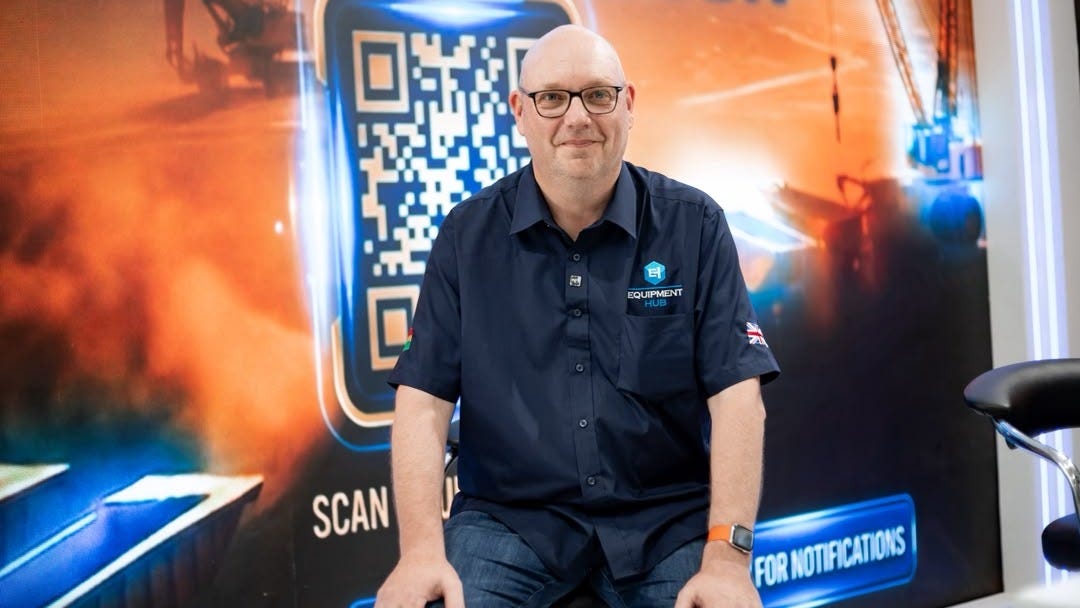
Asked what advice he would give to founders building in Africa, Bacon goes back to where he started. “Don’t wait for the big players to fix it. If you can see the gap, you’re probably the right person to close it. It took me years to connect these dots. The opportunity was always there.”
Equipment dealers, contractors, financiers and service providers can list free on the marketplace until August 2027. Visit equipmenthub.ltd or join the partner network at equipmenthub.ltd/service-partners.
Equipment Hub Ltd is a UK-registered company (no. 11078391) and a marketplace for plant and construction equipment serving Africa. It brings machines together with the services that make deals work: shipping, finance, inspection, insurance, export documentation and events. Founded in 2017 as Equipment Africa Ltd, the company supports equipment sourcing, ECA-backed project funding and asset disposal across the continent. Recover. Reuse. Reinvest.
