

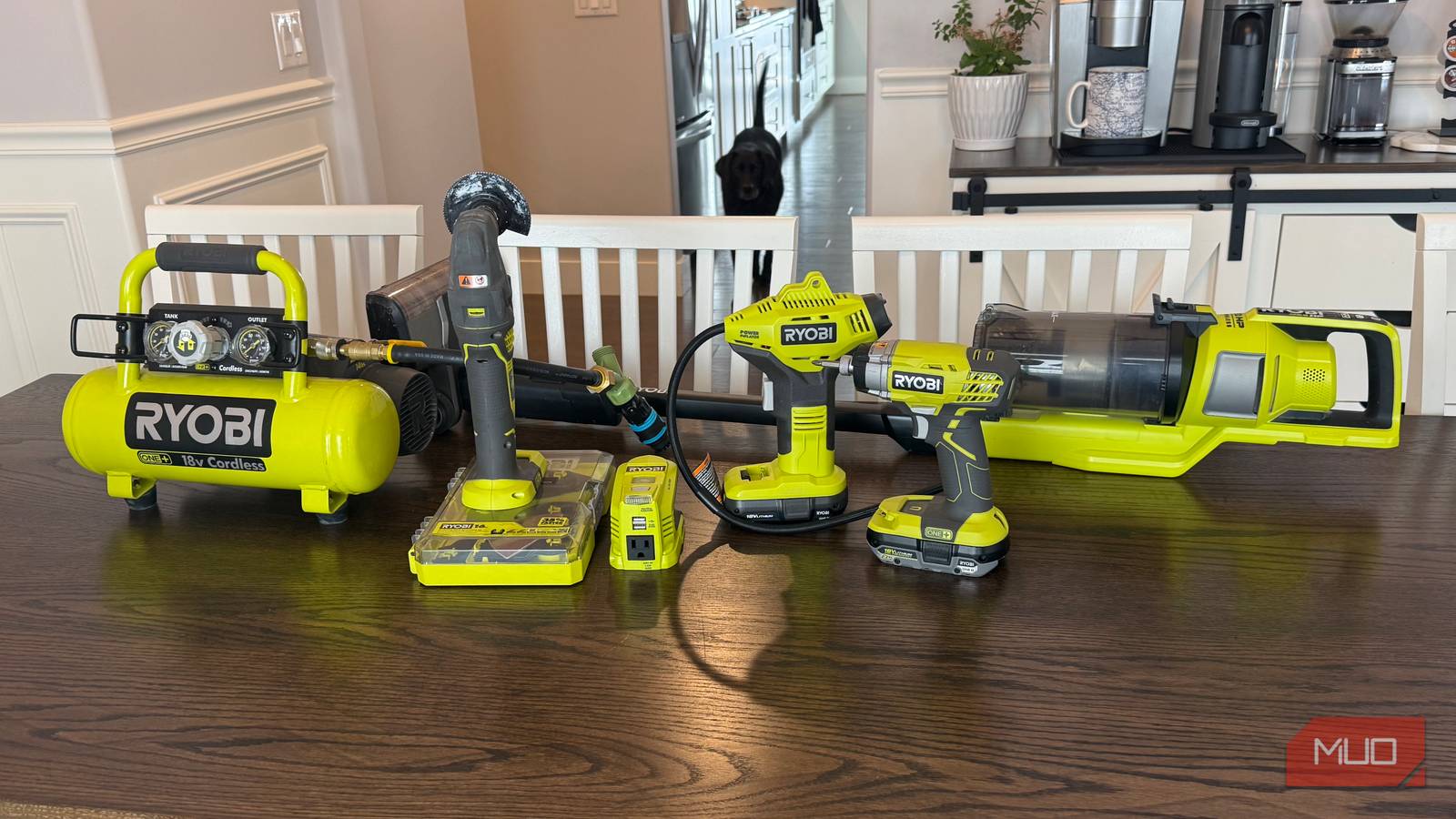
Every workshop has its headliners — the circular saw that rips through plywood, the drill that lives on the pegboard, the sander that gets pulled out for every furniture project. I’ve been adding to my Ryobi ONE+ collection for years now, and somewhere along the way I noticed something. The tools I grab most often aren’t the big names. They’re the ones that handle the annoying stuff, the cleanup, the tasks that used to eat up half my afternoon before I even started the real work. You won’t find these six on most “must-have” lists, which honestly surprises me. They share one 18V battery platform, and together they’ve probably saved me more hours than my table saw.
The Swiss Army knife of power tools
My Ryobi oscillating tool came home with me because I needed to trim door jambs for a laminate flooring install. Just that one task. With a handsaw, I’d be crouching at awkward angles for each doorway, trying to keep the blade level while my knees complained. An hour of that, minimum. The oscillating tool did all three in fifteen minutes flat. I stood there afterward, wondering why I’d put this purchase off for so long.
What I didn’t expect was how often I’d keep using it. Notching drywall for an electrical box, scraping dried caulk off a window frame, getting into the tight corners of a cabinet where no orbital sander will ever fit — I used to jury-rig solutions for jobs like these. Sometimes I’d skip them entirely because the hassle wasn’t worth it. These days, those same jobs take five minutes. Part of that is the attachments—wood blades, metal blades, sanding pads, scrapers, and a grout remover I’ve used exactly once. Swapping between them is quick since they all click into the same mount. No hex keys to dig around for.
The ONE+ impact driver
Why your drill isn’t enough
I spent years thinking my cordless drill did everything. Swap in the right bit, squeeze the trigger, done. That was my thinking, anyway. A neighbor loaned me his impact driver when I was putting up a fence last spring. After about ten minutes with it, I wondered what I’d been doing all those years with just a drill.
It’s not just about raw power, though there’s plenty of that. The way an impact driver works — short, rapid bursts of rotational force — means you can sink a three-inch screw into oak without the bit camming out or your wrist paying for it later. I rebuilt a deck last summer and drove probably two hundred screws in a single weekend. My old drill would have left me sore for days. The Ryobi impact driver made it feel almost easy, and I wasn’t stopping every few minutes to deal with stripped heads. Plus, it’s compact enough to fit into spaces where my chunkier drill just won’t go. At $50–$70 for the bare tool, it’s the kind of purchase you kick yourself for not making sooner. Honestly, impact drivers are a tool worth buying twice for your home.
The ONE+ portable air compressor
Beyond tire inflation

Most people buy these for topping off car tires. Mine does that fine — if you want something dedicated for the car, Ryobi’s tire inflator is the one tool I’d keep in the car all winter. But I’ve gotten way more use out of the compressor in my workshop, solving problems I used to just live with.
Sawdust gets everywhere. I mean everywhere. It packs into the blade guard on my miter saw, drifts across my drill press, and works its way into crevices no brush can reach. I used to spend a solid ten minutes at the end of each session wiping things down and picking debris out of corners, which meant I often just didn’t. The mess accumulated. Now I give everything a blast of air before I leave with my Ryobi air compressor, and the whole process takes maybe thirty seconds. Mid-project, it’s useful too. I’ll blow dust off a piece before finishing it, clear a cut line so I can actually see what I’m doing, and even speed up glue-ups with some targeted airflow. I also use it to clear some irrigation lines for my hydrangeas before winter. Because it’s cordless, I actually reach for it. My old corded shop compressor mostly sat coiled up in the corner, too much hassle to drag out for small jobs.
The ONE+ 150-watt power inverter
Portable power without the cord tangle

There’s always something that needs plugging in. A phone. A work light. That corded sander you keep meaning to replace. And then you’re digging through a drawer for the extension cord, stringing it across the floor, stepping over it for the next two hours. The Ryobi power inverter killed that whole routine. Snap a ONE+ battery onto the base, and you’ve got a standard AC outlet plus two USB ports wherever you need them.
Mine lives on the workbench most of the time. I charge my earbuds on it, run a little work radio, and sometimes power a corded detail sander I haven’t gotten around to replacing. When I’m out in the driveway or the yard, the inverter comes along, and I don’t think twice about outlets. It won’t handle high-draw stuff —forget running a shop vac off it — but for LED lights, phone chargers, and smaller corded tools, 150 watts covers more than you’d think. At $30–$40 for the bare tool, it’s cheap flexibility.
The ONE+ 6-port fast charger
The end of dead battery delays

This one doesn’t do anything exciting on its own — it just charges batteries. But when you’ve got a dozen ONE+ tools, and you’re rotating through them on a busy project day, battery management becomes its own headache. I used to have three single chargers scattered around the garage (and one inside for my converted Dyson V8 vacuum), and I’d still end up waiting on a dead battery at the worst possible moment.
The Ryobi 6-port charger fixed that problem entirely. Mine hangs on the wall by my workbench. Every battery I own slots into one of those six ports, charges up in sequence, and stays topped off until I need it. Ryobi says it’s 30% faster than the previous charger — I haven’t put a stopwatch to it, but I’ve stopped waiting around for batteries to charge, which is really the point. The built-in USB port is a nice bonus for phones and earbuds. Nothing flashy about any of this, but a workshop runs on charged batteries, and now I’ve always got them.
The ONE+ cordless stick vacuum
Quick cleanup without the shop vac hassle
I know how this sounds. A stick vacuum? In a workshop? But hear me out, because the Ryobi Stick Vacuum gets more use than half my power tools.
Sawdust multiplies when you’re not looking. A small pile on the workbench drifts into a thin layer across everything nearby. Shavings hit the floor, stick to your boots, follow you into the kitchen. My wife loves that. And good luck getting an accurate measurement when you’re working on a dirty surface — you’re adding error before you’ve even marked the cut. The shop vac handles serious messes, but dragging it out for a handful of shavings always felt like too much production. So I’d skip it, let things pile up, and deal with the chaos later when I couldn’t stand it anymore. The Ryobi stick vacuum changed that math completely. It’s light, it’s always “charged” (thanks to the swapable batteries), and I can grab it for a quick pass that takes thirty seconds. No dragging hoses, no unwinding cords. Just clean up and get back to work.
The real value is in what you don’t waste
What ties these six together isn’t power or precision. It’s that they cut out the annoying parts of shop work — the stuff that happens before and after the actual building. Setup. Cleanup. The fifteen-minute sidetracks that balloon a simple project into an all-day ordeal. You’re not going to build a bookcase with a stick vacuum or a battery charger. That’s fine. These tools run in the background, keeping the shop operational so you can focus on what you’re actually trying to make. And if you’ve already bought into Ryobi’s ONE+ system, the cost to add them is pretty minimal. You’ll notice the difference the next time you start a project, and everything just works.
