

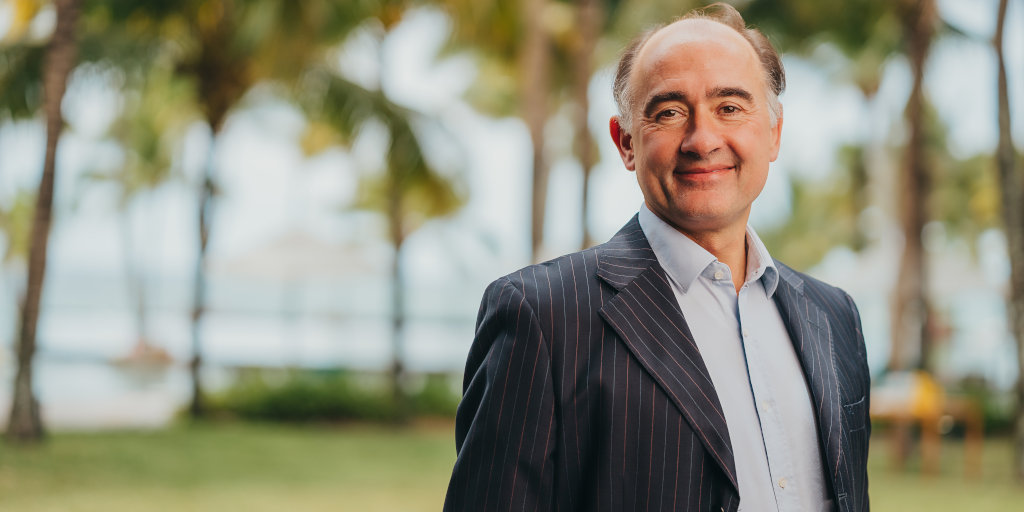

Alexis Caude
Interview with Alexis Caude
MANAGING PARTNER, ADENIA PARTNERS
Lives in: Mauritius
Before becoming an investor in Africa, French-born Alexis Caude was a successful entrepreneur. At age 36, he was in a position to retire after selling his online publishing business, but went on to start several other companies. He eventually moved to Mauritius and became a managing partner of Africa-focused investment firm Adenia Partners. How we made it in Africa editor-in-chief Jaco Maritz spoke to Caude about his entrepreneurship journey, his investment successes on the continent, and how he manages his personal money.
In 1999, Alexis Caude launched his first business developing websites for well-known football players in France. He modelled the company on an American firm that built platforms for NBA and NFL stars, anticipating that the US business would acquire his operation when it expanded into Europe.
But the idea didn’t work out as expected. Although he successfully convinced football players to set up websites, the company struggled to generate revenue from them.
The connections established during this project allowed him to pivot. He began producing television content featuring the athletes, which he sold to broadcast networks.
However, this venture lost momentum following the 2002 FIFA World Cup. France was eliminated in the group stage, failing to win a single match or score a single goal. In the wake of the tournament, television stations lost interest in broadcasting content featuring football players.
Three years into his entrepreneurial career, Caude was back to square one.
Following these setbacks, an opportunity arose when the website sports.fr went bust. He decided to buy the business and its small team of journalists at a “distressed price”, intending to build a sports media company.
As demand for online media exploded, the website quickly became popular, generating revenue from advertising and content sales.
Caude credits the company’s success to a combination of good timing and a specific deal to provide sports content to the French mobile network operator Orange. This contract gave the company the critical mass to pay for journalists, while also bringing substantial visibility to the brand.
In 2006, his online publishing business, Newsweb, went public on the Paris stock exchange and was subsequently acquired by the Lagardère Group. The transaction provided Caude with enough money to retire.
“I was, I remember, 36, so I was relatively young when I sold my company,” he says. “I stopped [working] for almost one year … enjoyed life.”
Following this hiatus, he returned to business, co-founding the sports betting company Betclic, which was sold two years later. In 2008, he launched another online publishing business – this one focused on financial information – which was also later acquired.
In 2010, Caude and a friend founded a hotel company called Valuestate. They bought their first hotel in Marseille, and have since expanded to several other cities. The advantage of the hotel business, he notes, is that it is easy to get bank loans because the building serves as collateral. “Hospitality is the only industry where it is difficult to lose money,” he explains. “Even if you have one or two bad years, you can always negotiate with the bank to [repay] a little bit later.”
A new chapter: investing in Africa
In 2015, Caude relocated his family to Mauritius, primarily for his wife’s career. She is a scientist and wanted to start a laboratory there. “I said, ‘Okay, I will retire and we will move to Mauritius,’” he explains.
“The kids were so happy to be on the beach after school. My wife was extremely happy having her dream job,” Caude recalls. But after about six months – and after finishing numerous books he had never found the time to read – he grew bored.
His next chapter was sparked by Antoine Delaporte, who founded the Africa-focused private equity firm Adenia Partners in 2002. Delaporte persuaded him to join the firm.
As a managing partner of Adenia, Caude oversees the firm’s investments in the Indian Ocean, East Africa and South Africa. The other managing partner, Stephane Bacquaert, is based in Morocco and handles activities in North and West Africa.
Targeting Africa’s small and mid-sized businesses
Adenia recently raised $180 million for its new fund, Adenia Entrepreneurial Fund I. The fund focuses on small and mid-sized businesses in Africa, which represent the largest yet most underserved part of the continent’s private sector. It invests between $10 million and $20 million per company.
The firm’s previous fund was much larger – at $470 million – requiring a minimum investment of at least $30 million per company. Caude explains that many businesses in Africa are simply too small to absorb that much capital. The new fund opens up a much broader pool of companies, allowing Adenia and its teams on the ground to close more deals.
The fund has already deployed capital into Maymana, a Morocco-based food company specialising in baked goods, speciality groceries, and gourmet catering services.

Adenia has invested in Moroccan food company Maymana.
Selling solar after South Africa’s blackouts ended
In 2021, Adenia made its first South African investment in Herholdt’s, a distributor of renewable energy equipment like solar panels, batteries, and inverters. At the time, South Africa was grappling with chronic electricity shortages, known locally as load shedding, which left some regions without power for up to 10 hours a day in severe instances. This drove many households and businesses to adopt solar power solutions. In the first three years of Adenia’s investment, Herholdt’s revenue grew about tenfold.
However, by March 2024, load shedding largely stopped thanks to improved performance at the national utility Eskom’s power plants, combined with reduced demand as so many households and businesses had already switched to solar. So where did the sudden end of blackouts leave Herholdt’s?
Caude says the business has traditionally been split between two segments: retail consumers and corporate clients. While demand from households has slowed, the company has doubled down on commercial and industrial buyers – a segment that continues to perform well.
Caude points out that solar power in South Africa is more economically viable than in markets like Europe. He notes that self-generated renewable power is much cheaper than buying electricity from Eskom.
Winners and losers
When asked about Adenia’s top deals, Caude highlights Quickmart. In 2019, Adenia invested in the Kenyan supermarket chain and merged it with Tumaini Self Service, a local retail operation it had acquired the previous year.
At the time of the acquisition, Quickmart and Tumaini had a combined network of 25 stores. Today, the unified chain has 67. “It will continue to grow,” Caude says. “Probably the type of growth you can only find on the African continent.”

Caude highlights Kenyan retailer Quickmart as one of Adenia’s most successful investments.
Another standout deal is Mauvilac, a paint and coatings manufacturer in Mauritius, which the firm has since exited. Adenia acquired a 95% stake in the business from its founding family. Under Adenia’s ownership, the company was professionalised and scaled up, leading to a successful sale in 2020 to the Dutch paint manufacturer AkzoNobel.
Not every investment has gone according to plan. Caude cites DDP, an outdoor advertising company in Ghana. Because Adenia invests in euros and dollars, a sharp depreciation of the Ghanaian cedi meant the business underperformed in hard-currency terms.
How he invests his personal money
Caude takes a somewhat conservative approach to his personal investments. He continues to invest in the hospitality sector in Europe and the US, an industry he knows well.
He also holds gold and US equities, leaning toward value stocks rather than the technology-driven momentum category. When it comes to equities, he buys both index funds and individual stocks.
Referencing Warren Buffett, Caude explains that if one doesn’t have the time to study individual stocks, it is better to buy an index. However, he does buy individual stocks himself. “I also buy stocks directly when I think that I have an edge or when I think that I know the industry well,” he says. “Then I try to apply the same method that we do in private equity: analyse the return on invested capital, analyse the competitive positioning of the company, understanding the price [and] the future growth.”
Because he is also an investor in Adenia’s funds, he needs to keep liquid assets on hand to contribute capital every time the firm makes a new investment. For this reason, he holds Swiss francs, a currency he favours for its ability to retain its value.
His investments also include an art collection, which connects directly to his personal passion for painting.
Start early and just try
Caude advises young people to try what they want to do, rather than not trying at all. He does not believe that career success demands absolute passion, arguing that people can thrive in fields they are not entirely passionate about. For aspiring entrepreneurs, his message is to start as early as possible.
