

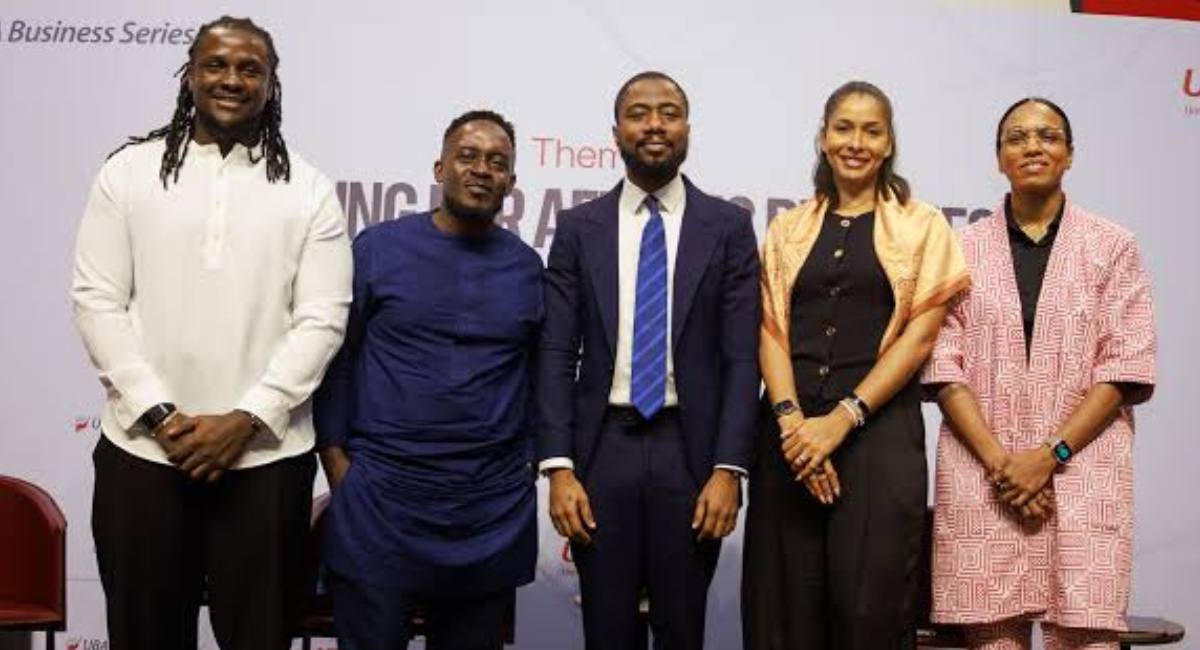
For a certain kind of African musician, artificial intelligence (AI) remains the enemy, the technology that steals jobs, flattens creativity, and turns songwriting into a mere prompt. Jude Lemfani Abaga, popularly known as MI Abaga, is not one of them. Speaking at a Lagos business panel earlier this month, the rapper-turned-tech-entrepreneur made a compelling case that clinging to AI anxiety is the real threat to a modern creative career.
Abaga spoke at the fourth edition of United Bank for Africa’s quarterly SME Business Series, held at UBA House on Marina on Thursday, 16 July. Themed “Building for Africa’s Realities: Turning Consumer Feedback into Technology-Driven Solutions”, the session placed Abaga alongside Chowdeck co-founder and CEO Femi Aluko and Octerra Capital managing partner Ashim Egunjobi, with media entrepreneur Adaora Mbelu moderating. While the brief centred on how African founders build products people actually want, Abaga’s remarks on AI emerged as the panel’s most pointed takeaway for the creative sector.
Femi Aluko opened the founder-led discussion with Chowdeck’s own operational reckoning. The food delivery platform learned early that Nigerian consumers do not represent a monolith. Purchase data revealed nuanced behaviours: some customers prioritise speed, while others will happily wait an extra fifteen minutes to reduce delivery costs.
Because spending habits shift as monthly salaries deplete, this rhythm directly influences Chowdeck’s pricing, logistics, and restaurant partnerships. Aluko credited this close reading of consumer data with the birth of Chowstore, a spin-off business that grew organically from observing actual app behaviour rather than relying on initial assumptions.

Abaga picked up this thread, pointing it directly at the music and creator industries. He recalled his initial assumption that creators and their commercial partners primarily needed a transaction platform. Once he built for that assumption, however, he discovered that what creators actually required was for their underlying, day-to-day problems to be solved.
“It’s more like relationships and hardcore agency, and then the tech can sit and make that transaction easier,” Abaga noted.
MI Abaga calls AI the ultimate creative multiplier
Turning directly to AI, Abaga framed the technology not as an existential threat but as an exponential multiplier for talent. He pointed to industry heavyweights like Kemi Adetiba, Adaora Mbelu, Burna Boy, and Wizkid, noting that AI will allow these “really special creators” to “become even more special”.
His argument was highly practical, rooted in production economics and the elimination of administrative friction. Historically, albums by top-tier artists like Kanye West demanded an incredible recording budget to secure elements such as choirs and specialised drum programming. Today, AI studios can replicate some of those premium sounds at a much cheaper cost, effectively democratising high-end production.
Beyond sound creation, the broader creative process is frequently bogged down by tedious administration, from registering rights and uploading files to distribution platforms to setting up pitch decks and sending out proposals. Tackling this meaningless labour is exactly the vision behind Abaga’s company, Tasck, which aims to leverage AI to handle these burdens. With these tools, creators can write business proposals and design professional decks in a mere second, allowing them to match with relevant businesses and audiences with unprecedented speed.
Abaga also pitched AI adoption as a massive macroeconomic opportunity rather than a defensive necessity. The global creative industry is currently valued at over $2 trillion and is projected to reach $3 trillion very quickly due to modern content consumption habits. Furthermore, these massive financial projections might actually be under-projecting the market’s true ceiling.

He challenged young Africans to position themselves inside this growth by creating an “Andela model” for the creative arts. According to Abaga, Africa’s positioning offers distinct strategic advantages. He envisions a future where thousands of young people in Nigeria and across the continent utilise AI tools to provide vital services to the global market, effectively solving substantial problems for international clients. Massive global industries like Hollywood, which require services demanding extensive compute and manpower, stand as ideal offtakers for this African talent.
Furthermore, Nigerians possess a highly competitive grasp of the English language compared to the rest of the globe. This linguistic fluency, combined with an inherent creative edge, perfectly positions African creatives to supply high-demand technical services such as subtitling, film colouring, sound design, set design, and script editing. Looking at this intersection between technology and creativity is the “best way for us to think holistically about where we are in this moment”, he argued.
Meanwhile, it’s important to note that Abaga’s comments should not be read as a formal AI policy for the Nigerian music industry but as one influential voice making a case for an industry he had helped build. Other prominent Nigerian musicians have previously voiced more sceptical views on AI’s creative risks, arguing it could make artists intellectually lazy. What Abaga added to that ongoing argument is that technology isn’t replacing talent but making their lives easier.
